A pilot should answer a production question
The Calling: La Santa Furia started as a compact vertical story test: a masked wrestling drama where faith, secrecy, and arena spectacle collide in a first episode titled The Mask in the Green Room.
That is already a useful micro-drama engine. There is a visible identity system, a physical arena, a private moral conflict, and a character who can be read in one frame. The question was not whether we could make a polished image. The question was whether the world could move fast enough to become a pilot, a poster, a cutdown, and a repeatable test route.
For me, that is where micro-drama production gets interesting. The format punishes vague development. If the first image, first line, and first dilemma do not travel on a phone, the audience leaves before the production has had a chance to explain itself.

The canvas keeps the work from becoming a prompt pile
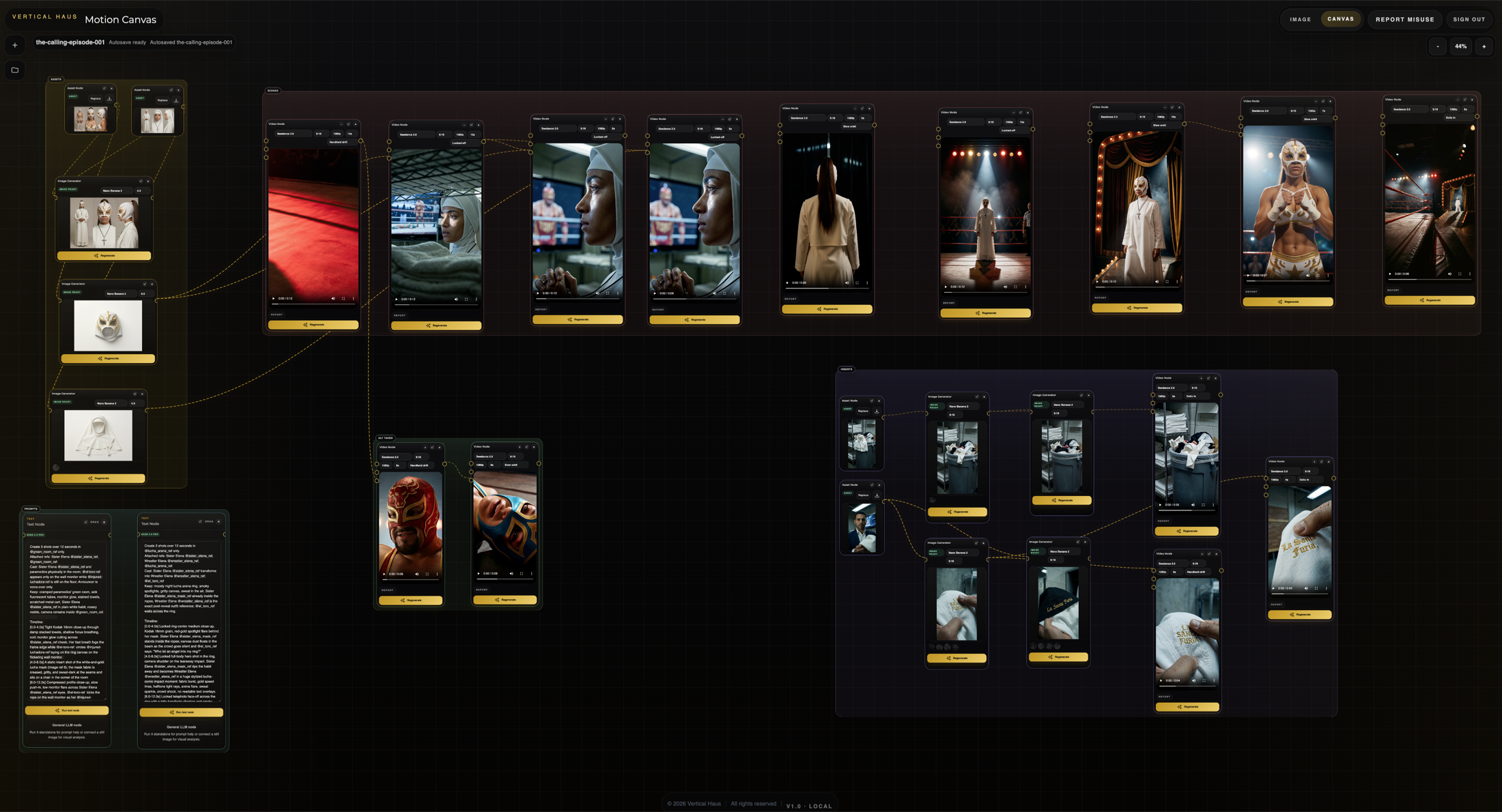
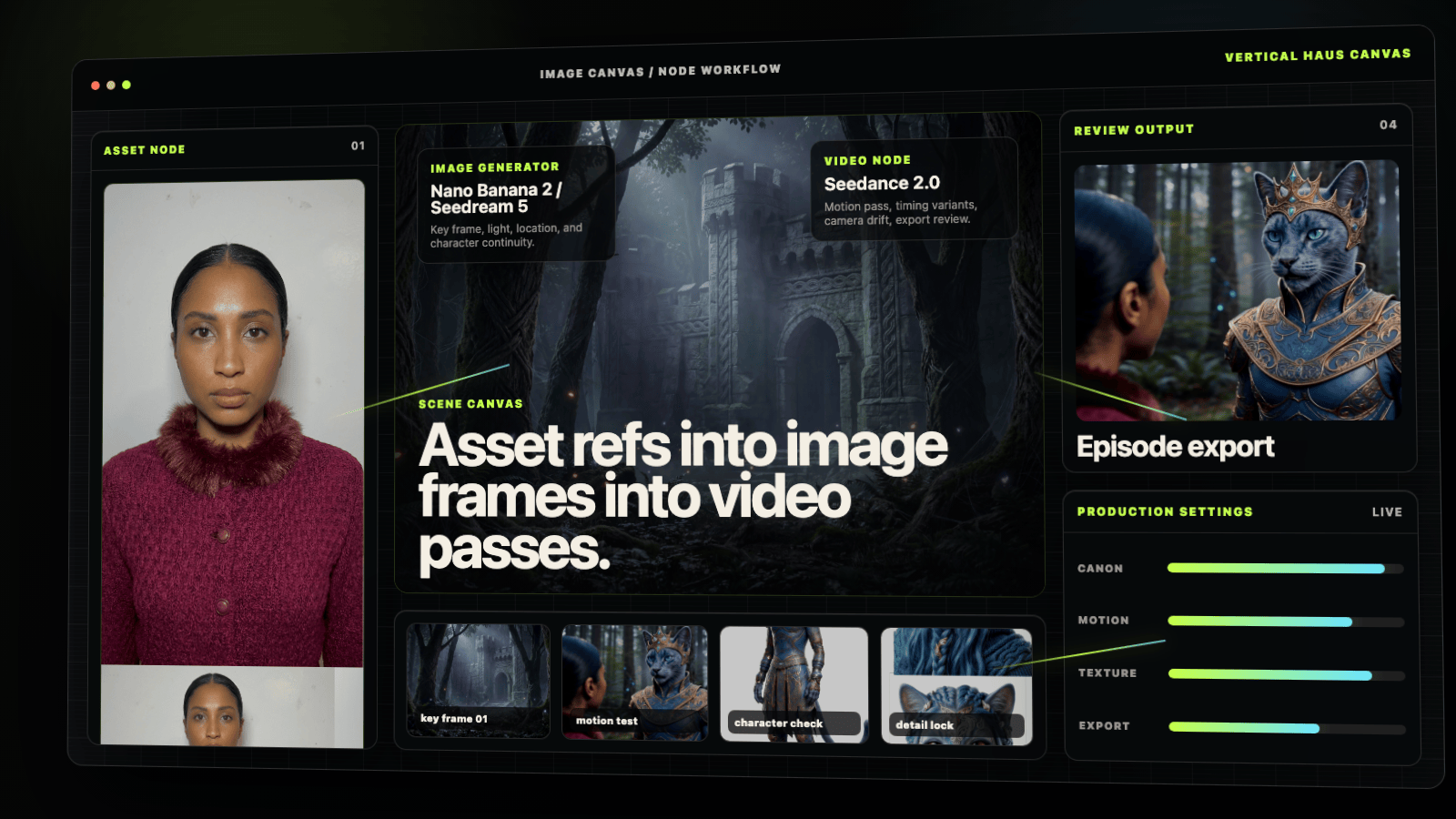
The image canvas matters because it turns scattered generation into a visible production object. Character references, asset nodes, prompt notes, Seedance 2.0 video passes, poster branches, alternate takes, and cutdown outputs sit in one workspace instead of disappearing across tabs, downloads, and half-remembered prompts.
That changes the behaviour of the team. A producer can see which frame fed which video pass. A director can compare the arena look against the character close-up. A social lead can see the cutdown route beside the episode route. The canvas makes the argument visible.
This is the difference between using AI as a novelty and using it as an AI production system. The model creates material. The canvas creates memory.
Character sheets make continuity cheaper to test
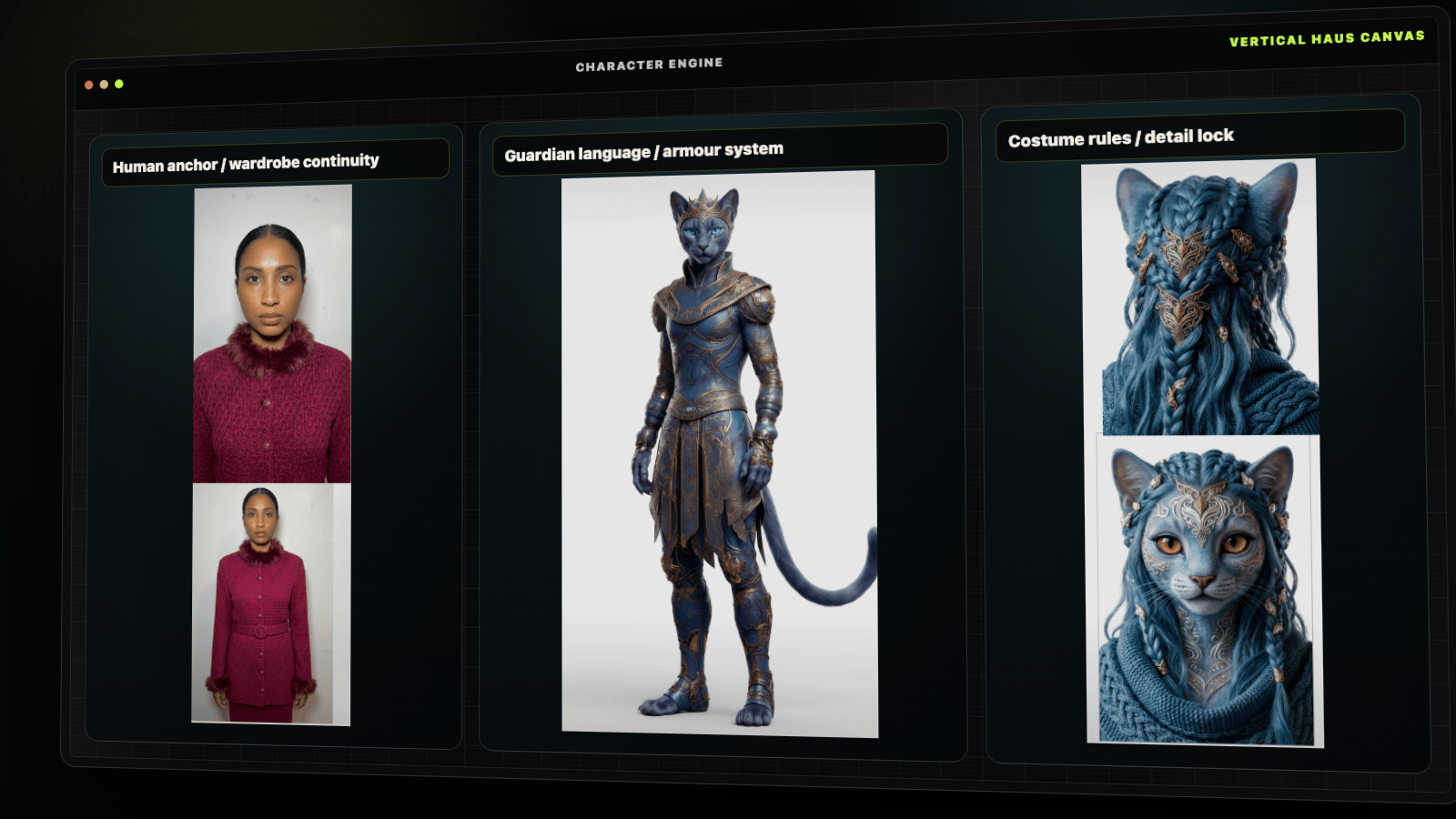
For a masked wrestling story, continuity is not only face consistency. It is mask design, robe shape, body language, faith iconography, arena geography, and the emotional distance between the person in the locker room and the performer under the lights.
The character-sheet layer gives the pilot something close to a production bible. It lets the team test wardrobe, stance, silhouette, and pose language before asking Seedance 2.0 to move the character. That does not remove the need for casting, costume, makeup, or performance direction. It gives those departments a clearer conversation to react to.
The stronger the character sheet, the less the prompt has to carry on its own. That is the practical win. Instead of asking one text prompt to remember the entire show, the system can keep visual rules attached to the project.
Seedance 2.0 is the motion pass, not the author
The integrated Seedance 2.0 layer is useful because it lets the team move from image proof to motion proof without rebuilding the project context each time. A still can become a video node, a video node can become a revised pass, and the report or review layer can sit next to the shot rather than after it.
That does not mean the model is directing the episode. The valuable human work is still story judgement: which shot creates pressure, where the edit should hold, whether the arena feels sacred or theatrical, whether the mask gives the character power or hides too much emotion.
I think this is the right creative posture for generative video. Treat it as a motion pass inside a production system. It can help test blocking, pacing, inserts, atmosphere, and social variants quickly. It should not be confused with the final standard of performance, physical production, or authored cinematography.
The retarget cutdown is part of the experiment
A vertical pilot is not finished when the episode export is finished. The cutdown matters because it tests the audience entry point. Which frame sells the world fastest? Does the mask pull attention before the caption does? Is the hook about faith, violence, secrecy, spectacle, or transformation?
That is why the pilot episode and retarget cutdown should be understood together. The episode tests whether the story has a first beat. The cutdown tests whether the world has a market-facing signal.
For micro-drama teams, this is the larger advantage of an owned image canvas. It can produce the episode, but it can also produce the things around the episode: posters, thumbnail routes, title tests, cutdowns, merch concepts, landing-page assets, and the evidence needed to decide whether a larger live-action production is worth building.
The useful future is hybrid
The point of this workflow is not to replace live production. It is to make live production smarter.
If a synthetic pilot proves that the character, world, and hook deserve more investment, the next version can be cast, shot, designed, performed, and finished with much clearer intent. The AI pass has already exposed weak spots: where the premise needs sharper conflict, where the look becomes generic, where the character needs human presence, and where the vertical frame needs better blocking.
That is a healthier relationship between AI and filmmaking. Use the canvas to move faster through uncertainty. Use live production where bodies, performance, texture, collaboration, and real-world constraint make the work better.
Build
Need a repeatable AI production workflow?
Mike designs the tools, review loops, and publishing systems that make it usable.
Launching a business of your own? Founder Launch OS connects the brand, offer, website and visual campaign in one guided Codex or Claude Code workspace.
Keep reading