The new standard changes the production question
IAB published Version 2 of its AI Transparency and Disclosure Framework on 18 August. It applies to paid, sponsored or brand-controlled advertising and marketing communications, including entertainment or editorial assets when they are repurposed as ads. Its central test is materiality: would the AI use cause a reasonable consumer to misunderstand the authenticity, identity or representation in the work?
That is more useful than asking whether AI touched the file. Routine post-production, standard enhancement and clearly fantastical treatment do not automatically carry the same disclosure need as a photoreal synthetic person, a fabricated action by a real performer or prompt-generated footage presented as reality. The framework is voluntary and does not replace law, contracts, platform policies or sector rules. Where a binding requirement is stricter, the stricter requirement wins.
For a brand commissioning work, the important line is operational: IAB puts ultimate accountability for the assessment with the advertiser, meaning the brand and/or agency. A model vendor can describe its metadata. A production company can document the shot. A platform can render a label. None of those hand-offs removes the advertiser's need to reach and retain a defensible decision.
Use two layers: audience disclosure and asset provenance
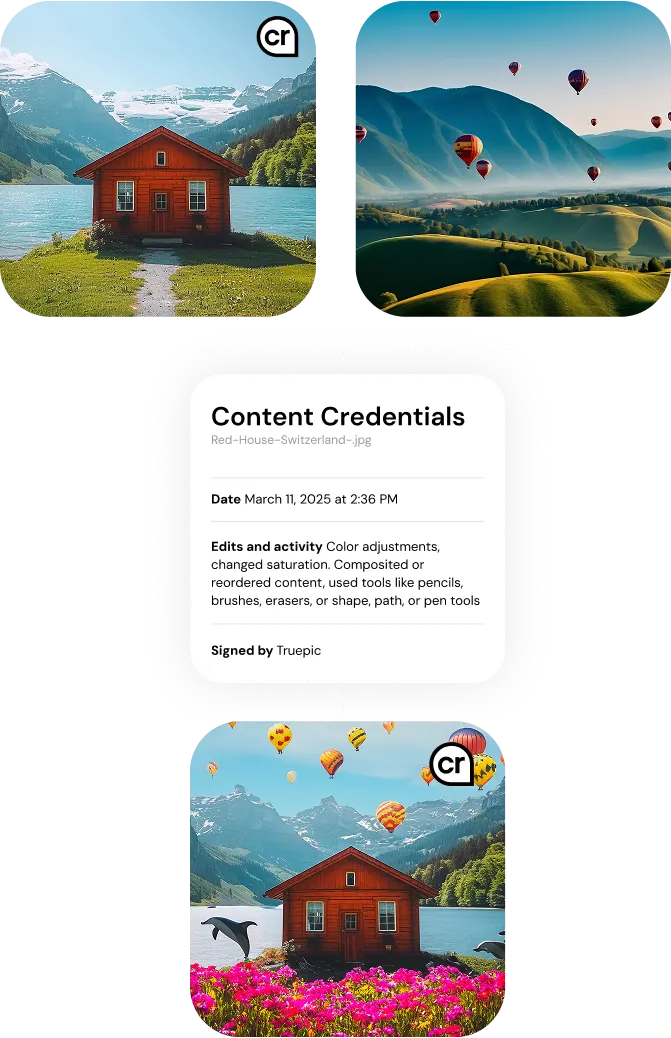
IAB proposes two connected layers. The awareness layer is what a person can perceive: a text label, visual indicator or spoken disclosure placed where it can be noticed and understood. The machine layer is structured provenance attached to the asset, with C2PA Content Credentials as the emerging mechanism for recording creation history and the disclosure decision.
These layers solve different problems. The visible label gives context to the audience at the moment it matters. Provenance gives platforms, reviewers and auditors a tamper-evident record of claims about how the asset was made. C2PA explicitly does not decide whether content is true or good; it makes signed assertions available for validation. A valid manifest is evidence about the record, not a creative clearance or legal opinion.
Treat either layer on its own as incomplete. A buried metadata field cannot help a viewer if the destination never reads it. A visible sparkle cannot explain who consented to a cloned voice, which shot was generated or whether the label survived a cutdown. The production record should connect the human-facing disclosure to the underlying asset, source, consent and approval evidence.

Build the disclosure gate before generation starts
Add a disclosure record to the job at briefing, not finishing. Give every synthetic element an asset ID and record the model and version, operator, date, prompt or instruction set, source references, intended claim, named people or places depicted, consent or licence, territories, channels and planned audience treatment. The record should survive even when an option is rejected, because rejected routes explain why the approved route was chosen.
Before making the asset, the producer and disclosure lead classify the proposed use. Is it clearly stylised or likely to be read as real? Does it invent an action, statement, event, location or result? Does it use a living or deceased person's voice, face or performance? Could the synthetic element affect a product claim, testimonial, price, environmental claim or evidence of performance? The closer the answer gets to identity, proof or apparent reality, the less appropriate it is to defer the decision until delivery.
This gate should be allowed to change the creative route. If an AI-generated product demonstration would need a disclosure that weakens the intended claim, the answer is not to hide the label. It may be to shoot the evidence, use AI only for non-material surroundings, or rewrite the concept so the synthetic construction is obvious and does not impersonate proof.
Use a trigger matrix, then preserve the reasoning
IAB's format guidance treats prompt-generated photorealistic image and video, certain synthetic voices, fabricated digital-twin actions, deceased-person replicas and conversational agents in ads as clear disclosure triggers. It also distinguishes common production assistance—such as resizing, denoising, routine colour work, internal ideation and some clearly non-realistic treatments—from material synthetic representation.
The matrix is a starting point, not an automated verdict. A generated tropical planet in a stylised drinks campaign and generated footage of a real beach in a travel advert can use similar tools while making very different claims about reality. YouTube likewise requires disclosure for realistic generated or meaningfully altered material, including generated footage of a real place used in promotion, while exempting many minor aesthetic edits and production-assistance uses.
Write one sentence explaining the judgement for every final asset: what changed, what a reasonable viewer might infer, and why the chosen disclosure is proportionate. That sentence is more valuable in review than a binary AI checkbox. It gives legal, client and platform teams something specific to challenge before money is spent and the work becomes public.
Test the destination, not only the master file
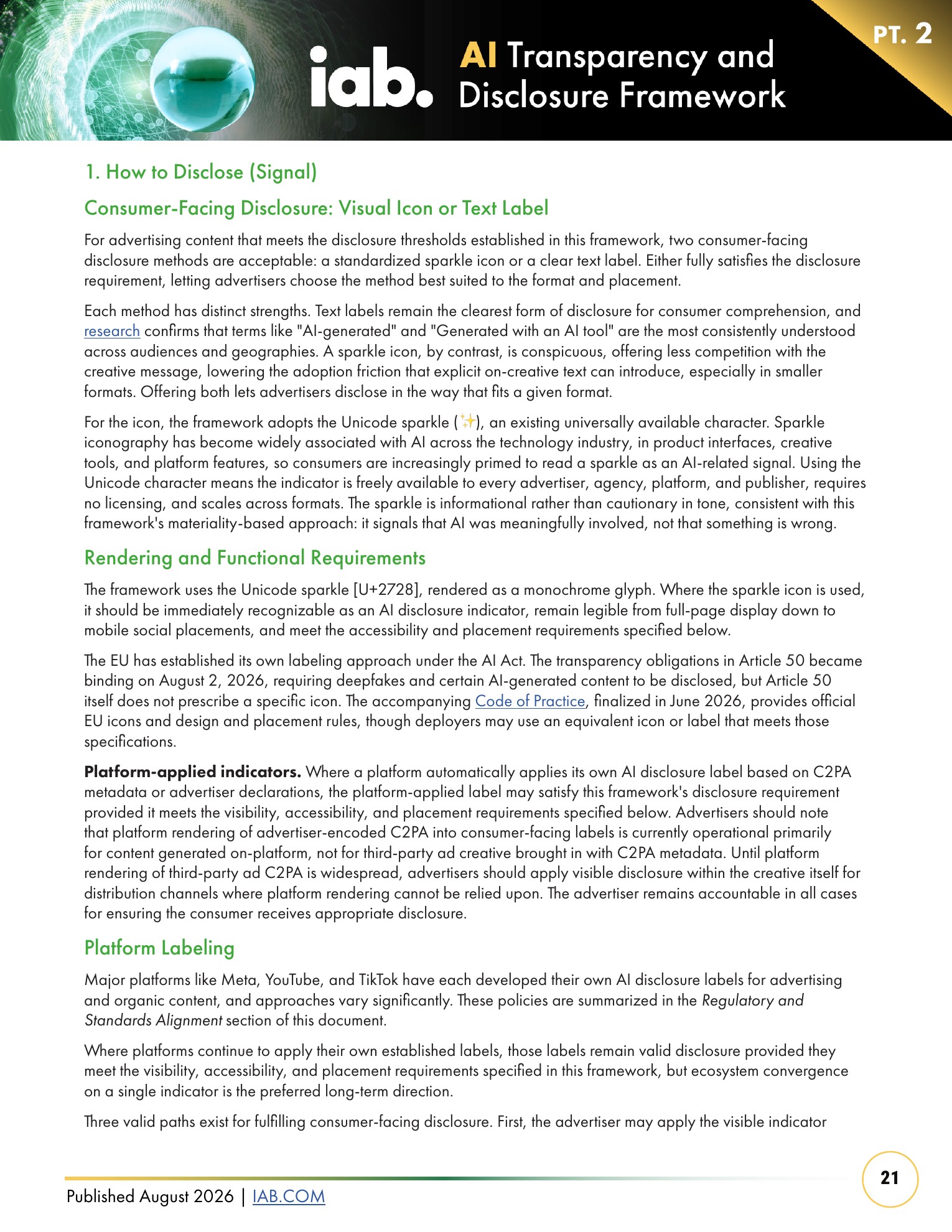
A disclosure can be correct in the edit and still fail in distribution. It may disappear when a 16:9 master becomes a vertical crop, become illegible on a mobile player, fall outside a six-second cutdown, vanish when sound is muted, or be stripped when an agency, publisher or ad platform transcodes the file. Machine-readable credentials can also be removed by unsupported export and delivery steps.
The release checklist therefore needs destination evidence. Export the actual placements, upload them to a test or private destination, and capture what a viewer sees on mobile and desktop. Confirm label wording, duration, position, contrast, audio alternative and language. Then inspect whether Content Credentials remain available after the platform has processed the file. If a platform reliably applies its own label, record the platform setting and observed result rather than assuming the setting was honoured.
Platform disclosure is an extra surface, not a substitute for the campaign record. YouTube may apply labels from creator answers, its own tools, C2PA metadata or detection systems, and says persistent non-disclosure can lead to penalties. Another destination may behave differently. Keep a per-platform release profile and re-check it when policies, interfaces or transcoders change.
Make approval a chain of named decisions
The cleanest workflow has four owners. The maker records the generation and source materials. The producer verifies asset identity, versions and delivery formats. The rights or legal owner decides whether consent, claims and territory rules are satisfied. The advertiser's disclosure lead approves the audience treatment and release. One person may hold more than one role on a small job, but the decisions should remain distinct in the record.
Approval should reference an immutable final identifier: a file hash, locked asset version or signed manifest. Otherwise a team can approve one cut and publish another. Retain the brief, source licences, talent permissions, model and terms snapshot, generation record, materiality reasoning, label artwork, accessibility treatment, platform screenshots and final approval together for the retention period set by the brand's policy.
This is also where procurement becomes practical. Ask agencies and production partners to return the completed asset ledger and disclosure assessment as delivery items. Ask model and platform vendors whether they create, preserve and expose C2PA data, what happens during export or transcoding, and how policy changes are communicated. Commercial safety is not a product adjective; it is the evidence chain available when a claim, performer or audience treatment is challenged.
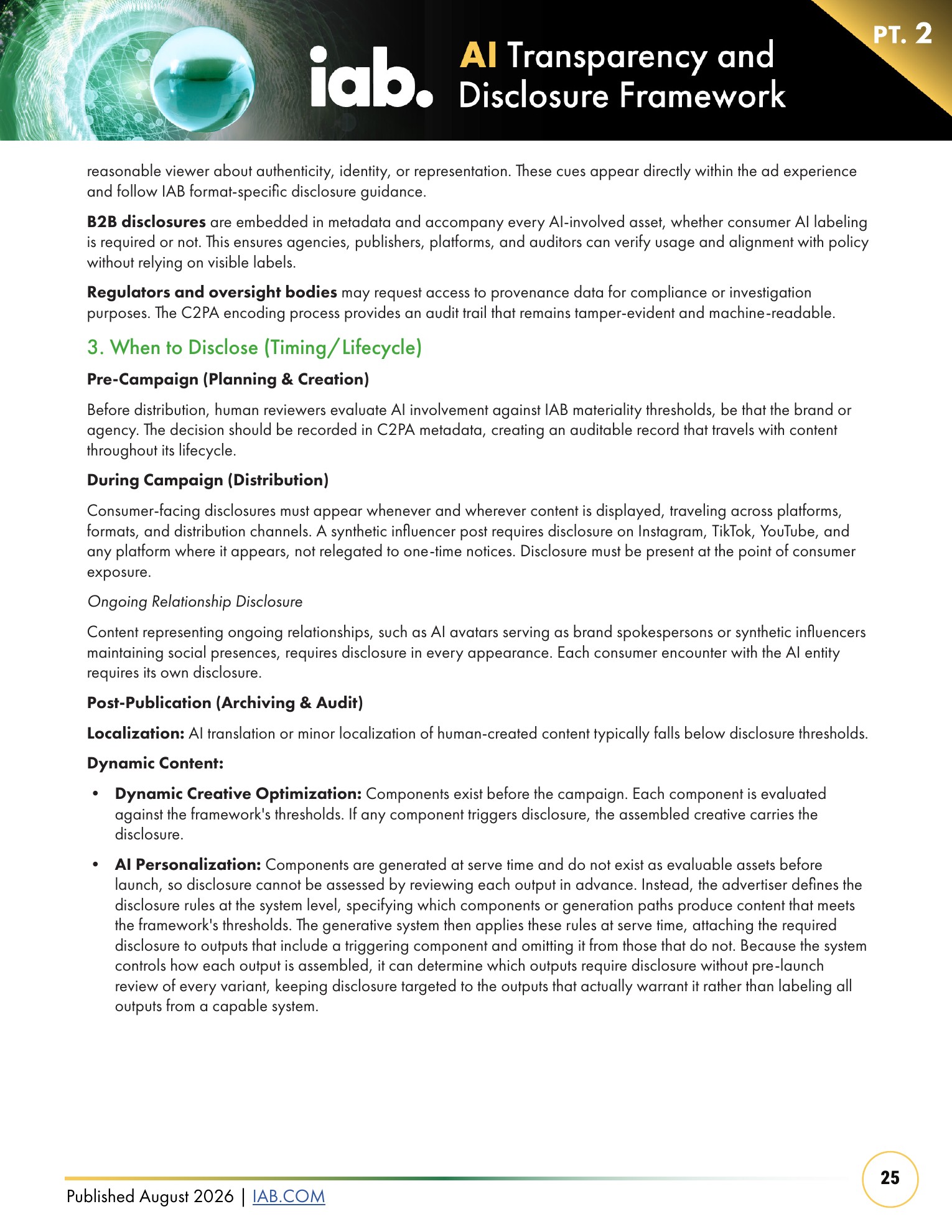
A minimum viable gate for the next campaign
Start with one owner, one ledger and one release block. Name the disclosure lead. Add synthetic-element fields to the creative brief and asset tracker. Require a written materiality decision before first client review. Prevent final delivery until the visible label, provenance record, consent, territory rules and destination tests are either approved or explicitly marked not applicable with a reason.
Then test the gate against three assets: an obviously stylised generated background, a photoreal generated shot of a real place, and a synthetic performance by an identifiable person. If the same checkbox produces the same treatment for all three, the system is too blunt. If nobody can say who makes the final call, the system is not yet accountable. If the reasoning cannot be connected to the published file, it is not auditable.
The point is not to make every use of AI look dangerous. It is to keep routine production work routine while applying visible, defensible transparency where synthetic media changes what the audience is being asked to believe. That is how disclosure stops being a disclaimer and becomes part of a production system a brand can actually buy, operate and defend.
Build
Need a repeatable AI production workflow?
Mike designs the tools, review loops, and publishing systems that make it usable.
Launching a business of your own? Founder Launch OS connects the brand, offer, website and visual campaign in one guided Codex or Claude Code workspace.
Keep reading