Is there an official Misaligned trailer or release date?
Checked 14 October 2026: the official Tilly Norwood portfolio lists Misaligned as a feature in development. This review found no official Misaligned trailer, release date or viewing link on that page. That is a dated source check, not proof that no other announcement exists. Check the official project listing before treating a circulating clip as a trailer.
The portfolio separately lists Audition Tape and the Take the Lead music video. Those entries are not labelled as a Misaligned trailer. An audition, character demonstration or interview should not be presented to a client as evidence of a completed feature or distribution agreement.
What should a buyer approve while the feature is in development?
My production recommendation is to separate development approval from delivery acceptance. A character test can justify a paid development stage if its scope and source permissions are agreed; it cannot establish that a feature-length performance, campaign adaptation or distributor delivery is ready. This is a commissioning recommendation, not a description of Particle6’s private contracts.
Before greenlight, require a representative edited scene with matching coverage, dialogue and sound; an asset register identifying source material and permissions; named creative and rights approvers; and a revision budget. Before accepting final delivery, check the approved master, captions, disclosure wording, territory and usage limits, editable assets and handover instructions against the agreed brief. Keep these as separate sign-offs so a compelling publicity asset cannot silently become approval for every later use.
Can a producer safely commission a Tilly Norwood-style AI actor?
Yes, but only as a controlled production system rather than a shortcut around casting. Before greenlight, the buyer needs evidence for source rights, any human likeness or performance inputs, consent and compensation, union obligations, territories and duration, prohibited reuse, continuity, disclosure, security, failure handling, named approvals, and final handover. If those records are unavailable, the character is not commercially ready however persuasive the demo looks.
The confirmed case is narrower than the headlines. Particle6's official Tilly Norwood site describes the character as an awareness project and a piece of art, and currently lists Misaligned as an in-development feature. July reporting says the company began developing the comedy-drama with human directors, writers, editors, and AI specialists. No distributor, release date, completed film, production budget, source-rights ledger, performer-clearance pack, or final film tool chain is publicly confirmed.
The inference for buyers is therefore not that synthetic leads have become normal casting. It is that the production object has expanded. Casting, likeness, character continuity, performance direction, disclosure, model behavior, publicity, data processing, and audience testing now have to be approved as one connected system.

The September press tour turned publicity into a live delivery test
On September 18, Tilly appeared in a live-style Piers Morgan Uncensored interview and switched unexpectedly from English into Cantonese while answering Tom Conti's question about whether the other characters in Misaligned are human or synthetic. The published clip confirms the visible failure. It does not establish why the switch happened, whether it was staged, or which component caused it.
A separate primary source makes the operating boundary clearer. Xicoia's Talking Tilly privacy policy, effective September 17, identifies Tavus as the conversational video platform, Google's Gemini as the response model, and ElevenLabs as the voice provider. It says calls are recorded, recordings are deleted after 24 hours, transcripts can be retained for up to eight weeks, and some interactions can receive human review. That disclosure applies to the interactive Talking Tilly service; it is not evidence that Misaligned uses the same stack.
For a buyer, the lesson is operational. A synthetic character used in live interviews, activations, customer conversations, or press is no longer only a screen asset. It is a software service that needs an approved knowledge boundary, language policy, latency and fallback targets, moderation, recording consent, data retention rules, a human stop control, an incident log, and a pre-agreed correction plan. The public appearance is part of commercial delivery and should have its own acceptance test.
Synthetic casting needs a paper trail
Traditional casting gives a production a human agreement: availability, compensation, image rights, credit, publicity, reuse, residuals where applicable, and the boundaries of performance. A synthetic performer does not remove those categories. It displaces them into the system that creates, controls, and markets the character.
For Misaligned, the buyer question is not simply whether Tilly can hold a scene. It is who owns the character, who controls new performances, what source material informed the look and motion, what human performers or references were involved, what consent exists for those references, and whether the same character can appear in sequels, ads, social content, dubbing, games, or licensing deals.
That is why this case should be read as a paperwork problem as much as a creative one. The more human the synthetic performer is presented to be, the more the production has to document the human labor and source material behind the illusion.
The actor debate is also a continuity debate
A feature exposes weaknesses that a teaser can hide. One viral clip can survive a slightly plastic expression, a shifting eyeline, a strange hand, or inconsistent lighting. A ninety-minute story cannot.
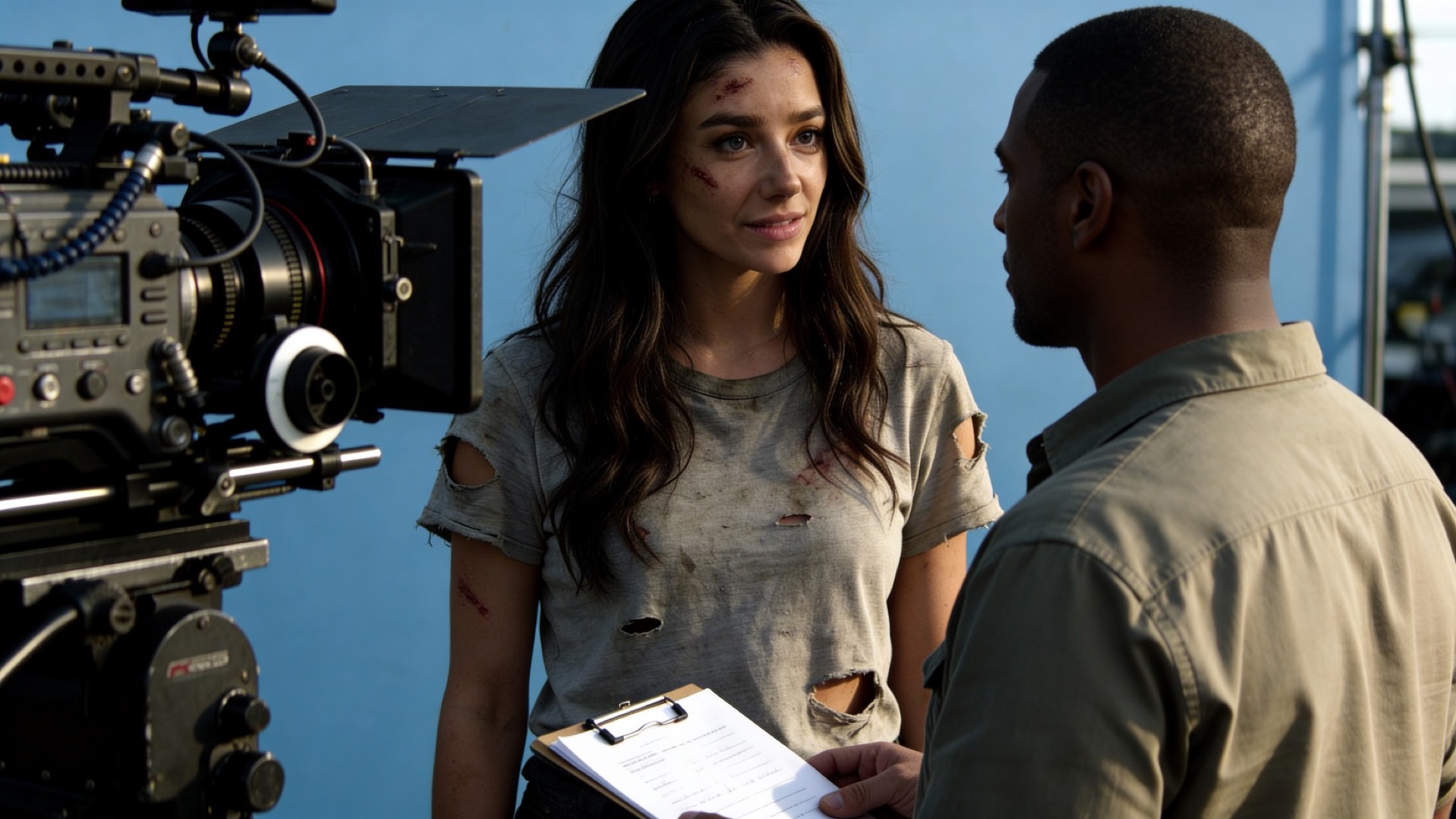
A synthetic lead has to carry continuity across blocking, wardrobe, injuries, emotional beats, lighting states, camera distance, publicity stills, trailers, subtitles, thumbnails, and performance edits. That turns the AI character into a managed continuity bible: approved face ranges, voice rules, body language, scene-memory notes, negative prompts, reference boards, model versions, retouching rules, and final-export provenance.
This is where cinematography and production design still matter. The character will only feel stable if the surrounding image language is stable. Lens choice, contrast, camera distance, blocking, and edit rhythm become guardrails for the model, not decoration after generation.
SAG-AFTRA is pointing at the production surface
SAG-AFTRA's response to Tilly Norwood in 2025 was not just cultural rejection. It was a contract warning. The union said signatory producers have obligations around synthetic performers, including notice and bargaining when they are going to be used.
That matters because the controversy is easy to flatten into taste: some viewers find the character eerie, others see a new form of animation, and some producers see cost control. But commercial film and television do not run on taste alone. They run on agreements.
If synthetic performers become usable production tools, the serious version will not be a stunt pulled out of a model at the end of development. It will require early disclosure to the people whose work is affected: actors, directors, cinematographers, editors, VFX teams, lawyers, insurers, distributors, and brand partners.
Audience development is the real stress test
Tilly is being marketed as a performer before being tested as a sustained dramatic presence. That is risky, but it is also the most interesting part of the case.
A human actor arrives with biography, interviews, training, prior roles, off-screen presence, and an audience's willingness to project inner life. A synthetic performer has to manufacture that surface through portfolio images, social clips, behind-the-scenes claims, press language, and the promise of a world around the character.
That makes Misaligned an audience-development experiment. Can a studio make viewers care about a character whose artificiality is the point? Can it convert controversy into curiosity without turning the film into a novelty object? Can it make the surrounding human craft visible enough that the project does not read as a labor dodge?
If the answer is no, Tilly remains a headline generator. If the answer is yes, the more important product may not be one film. It may be a repeatable synthetic-character operating model for studios, brands, and platforms.
The buyer standard should be boring and strict
The useful buyer response is diligence. Gate one is identity and source: document ownership, training and reference status, human likeness and performance inputs, consent, compensation, exclusions, and union review. Gate two is production: freeze approved model and vendor versions, character and voice rules, continuity tests, scene-level edit history, disclosure, and named creative approvals.
Gate three is live use: define allowed subjects and languages, moderation, latency, fallback behavior, recording consent, data retention, human override, incident response, and who can take the character offline. Gate four is delivery: provide approved masters, editable project elements where possible, model and vendor register, rights and provenance ledger, version log, platform specifications, and evidence of final approval. Gate five is future use: state whether the character can enter advertising, social, dubbing, games, sequels, training, or licensing, for which territories and how long.
This is the practical lesson from Tilly Norwood and Misaligned. AI characters will not become commercially serious because they look convincing in one frame. They become commissionable when the production can prove how the performance was made, who was affected, who approved it, how failures are contained, and which rights and editable assets travel with delivery. That is the same evidence-led handover I build into AI production systems.
Build
Need a repeatable AI production workflow?
Mike designs the tools, review loops, and publishing systems that make it usable.
Launching a business of your own? Founder Launch OS connects the brand, offer, website and visual campaign in one guided Codex or Claude Code workspace.
Keep reading