The handoff just became more important than the demo
On August 31, Runway added scene-referred ACEScg OpenEXR delivery to its API. The option is available for Gen-4.5 HDR generations and the video-to-HDR endpoint, with separate output choices for ACES 1.3 and ACES 2.0. The downloaded zip follows the existing EXR contract and includes colourimetry and provenance sidecars, plus a WAV file when the source contains audio.
That sounds like a technical release note. For a production company, agency or brand studio, it marks a practical threshold: generated footage no longer has to arrive as a display-ready MP4 that somebody tries to bend into the grade. It can arrive as floating-point frames intended for compositing inside an ACES-managed project.
It does not make an AI shot production-ready by itself. It makes a clean technical handoff possible. The team still has to agree which ACES version it is using, how the image will be viewed, what the sidecars mean, which transformations are allowed and what the client is actually approving.

What Runway is delivering—and what it is not
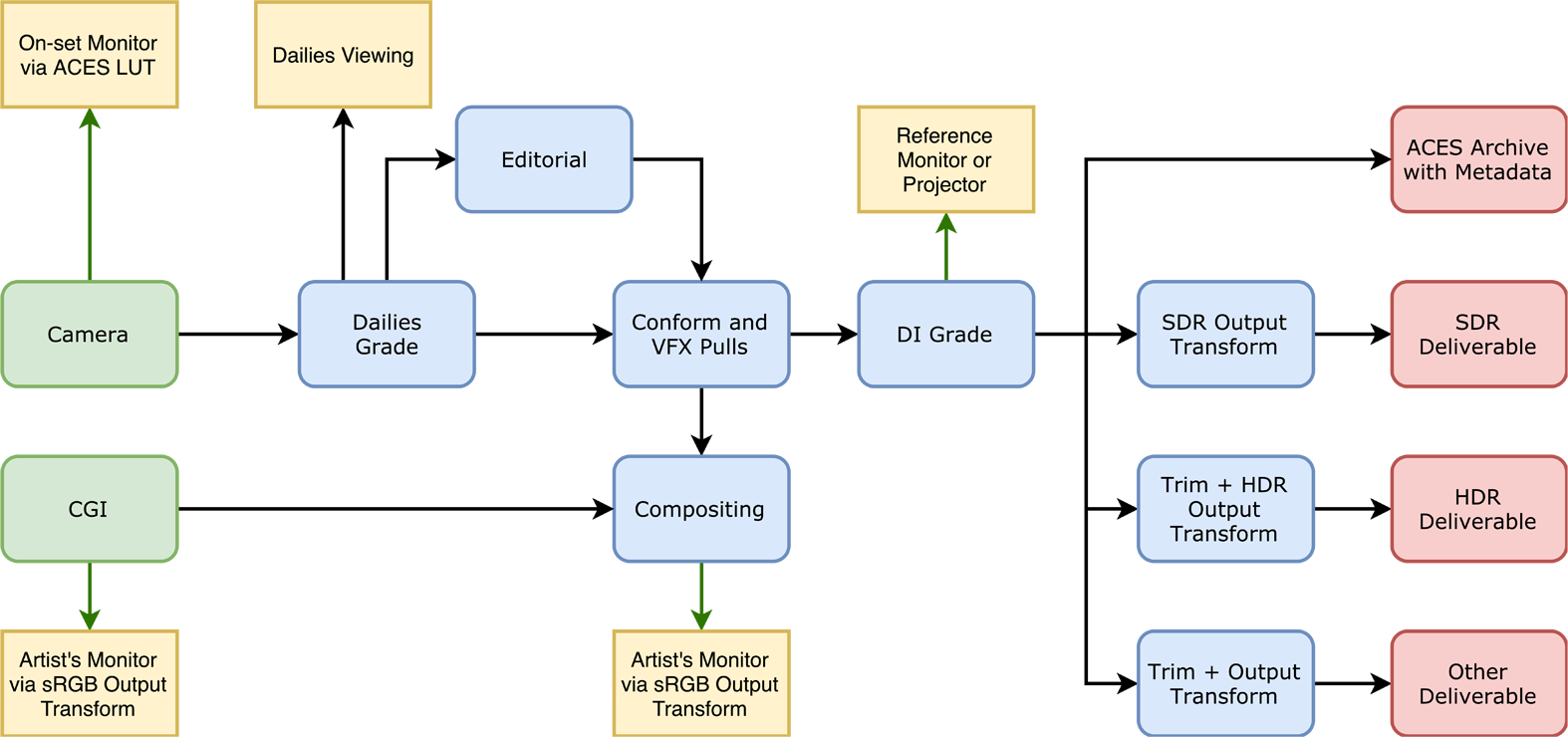
Runway says the picture is inverted through the matching ACES Output Transform for Rec.2100 PQ at 1,000 nits into ACEScg. In an ACES-configured compositing application, the sequence should be read with the stock ACEScg input and viewed through the matching ACES pipeline to reproduce the delivered picture.
That wording matters. This is not camera negative, and it does not reveal a physically measured scene that existed in front of a lens. It is a scene-referred working representation derived from Runway’s delivered HDR picture. It gives compositors floating-point headroom and a defined colour context; it does not turn generated pixels into captured light or guarantee that highlights, skin tones and saturated colours will behave like material from a particular camera.
The exact output choice also matters. The API names specify ACES 1.3 or ACES 2.0. If production requests one and the facility opens it under the other, the image can look plausible while still being wrong. ‘ACES’ is not a complete handoff note. The config version, colour space and intended viewing transform belong in the job record and the filename or manifest.
A viewable image is not necessarily the right image
ACEScg is a linear AP1 working space designed for rendering and compositing. Values above 1.0 are expected and should not be casually clipped. A desktop preview, an unmanaged image viewer or an editor interpreting the files as ordinary sRGB can therefore show something flat, dark, over-saturated or simply different from the intended result.
The dangerous failure is not always an obviously broken image. A wrong transform can produce a frame that looks respectable enough to circulate. Notes are then made against that accidental appearance, a grade compensates for it, and the error becomes embedded in later versions. By the time someone compares the master on a calibrated HDR display, the team is arguing about taste when the real problem is pipeline configuration.
Create one authorised viewing path for dailies and one for finishing. Render lightweight review proxies from the master sequence using the named transform, burn in the shot ID and version, and keep the EXRs immutable. Every reviewer should know whether they are judging composition, motion, integration, colour or the final display master.
Build the receipt before you build the composite
The Runway package includes provenance and colourimetry sidecars. Preserve them beside the untouched sequence. Do not let an ingest script unzip the frames into a shared folder, rename everything and discard the supporting files because the compositor only asked for images. Those files are part of the production receipt.
Add the information the delivery cannot know: project and shot ID, model and endpoint, generation job ID, prompt and approved references, reference rights, consent status for any identifiable person, generation date, operator, output-format string, ACES config version, checksum and approval state. If the shot is later retimed, painted, reframed or combined with live action, record that as a new derived asset rather than overwriting the source.
This is where commercial safety meets post-production. A producer should be able to answer two different questions: ‘Can we recreate and technically interpret this image?’ and ‘Are we entitled to use every input and depicted element?’ EXR and provenance metadata help with the first. They do not replace releases, licences, brand rules or legal review for the second.
Price the sequence, not only the generation
Runway lists the ACEScg outputs at the same additional rate as its other deep HDR profiles: 20 credits per output second, rising to 40 credits per second above roughly 4K. That surcharge sits on top of the generation or conversion path. Treat it as one line in a wider cost model rather than the whole price of a finished shot.
A frame sequence also creates operational cost. At 24 frames per second, a ten-second shot becomes 240 files before versions, proxies, checksums and backups. Upload time, storage, transfer to external VFX, conform time and archive policy can easily become more consequential than the API call—especially when a team exports every exploration at finishing quality.
Use a deliberate promotion gate. Explore and edit with efficient review media. Request ACEScg EXRs only for selected shots that need compositing, relighting, keying, paint, a managed HDR grade or long-term finishing flexibility. The buyer should pay for accepted seconds entering post, not for every generated second leaving the model.
The five checks I would run before client review
First, verify the delivery contract: expected frame count, dimensions, frame rate assumption, audio presence, sidecars and checksums. Second, open the sequence under the declared ACES config and input space. Third, compare the managed result with Runway’s reference delivery under the stated Rec.2100 PQ viewing condition rather than comparing two unmanaged windows.
Fourth, stress the image where pipeline mistakes hide: bright specular detail, saturated practicals, gradients, skin, motion edges and any element that will be keyed or tracked. Check for clipped values, banding, colour shifts and temporal inconsistencies. Fifth, make an SDR review output through an agreed transform and confirm that the creative intent survives the version most stakeholders will actually watch.
Record the result as a pass, conditional pass or rejection against the shot version. A conditional pass might allow editorial use while requiring paint or a replacement reflection. That is more useful than a chat message saying the shot ‘looks good’, because it tells downstream teams what was inspected and what remains unresolved.
A practical pilot for agencies and studios
Choose one representative shot, not a showreel image designed to flatter the tool. Include a face or product, a bright source, a saturated colour, camera movement and one planned VFX operation. Send the same package through the people and applications that would handle a live job: producer, editor, compositor, colourist, review platform and archive.
Ask each handoff to return evidence. Can the editor make a reliable proxy? Does the compositor see the intended image without a custom guess? Can the colourist identify the config and transform? Do the sidecars remain attached? Can production retrieve the prompt, references, rights record and approval decision from the shot ID? Measure transfer time and storage as well as render cost.
The release is useful because it moves AI video closer to the language of established finishing. The opportunity is not to declare the gap closed. It is to remove one avoidable translation step, then make the remaining decisions explicit. When the next approved AI shot arrives, nobody should have to ask what colour space it is, which picture was signed off or where the evidence went.
Build
Need a repeatable AI production workflow?
Mike designs the tools, review loops, and publishing systems that make it usable.
Launching a business of your own? Founder Launch OS connects the brand, offer, website and visual campaign in one guided Codex or Claude Code workspace.
Keep reading