The cost signal is too large to dismiss
On July 20, Runway published what it calls a longitudinal study of hundreds of enterprise customers using its platform for advertising, brand content, broadcasting, games, film and other media production. Its headline finding is not a marginal efficiency gain. Runway says production costs commonly fell by two to three orders of magnitude while timelines collapsed.
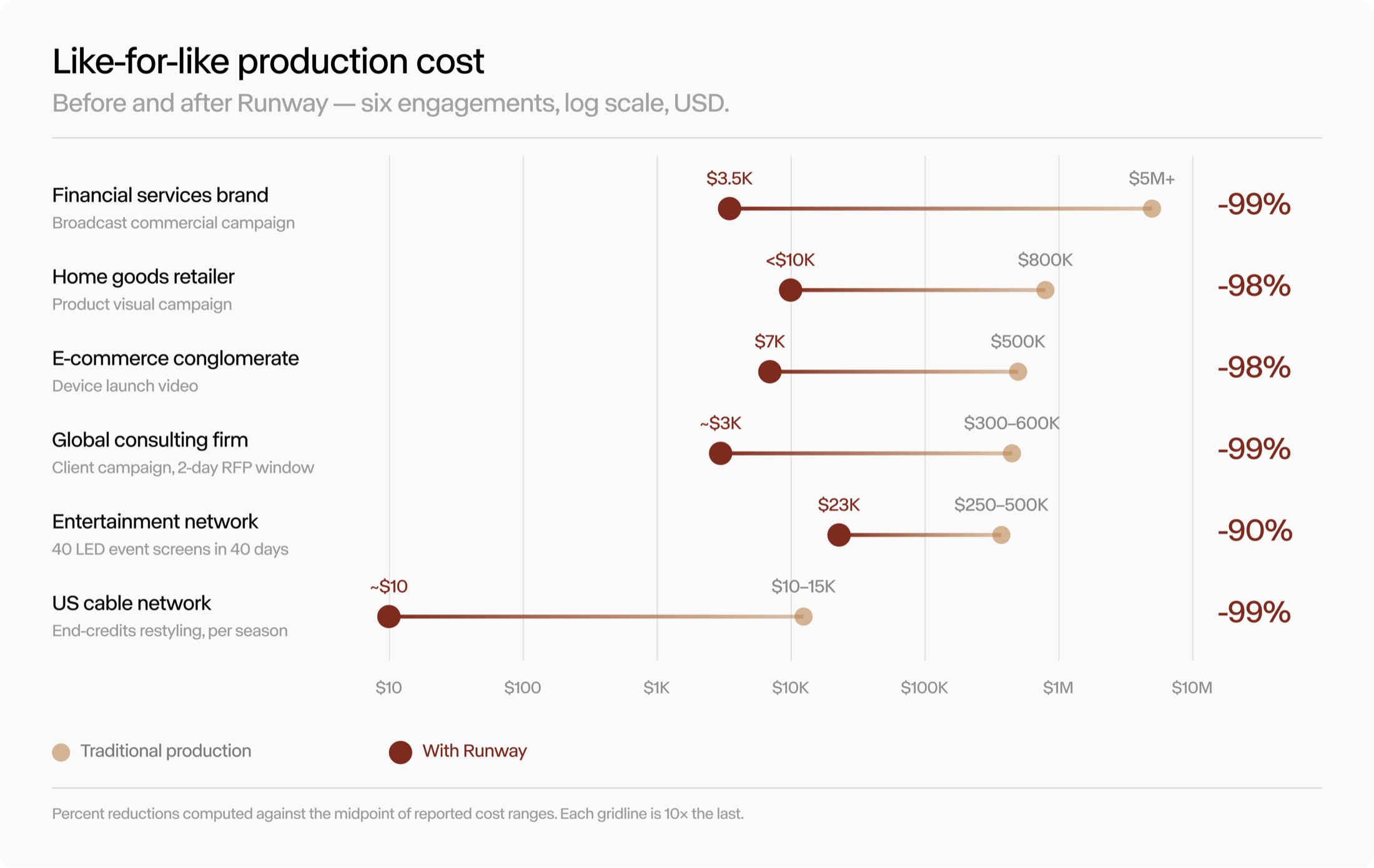
The examples are striking. A financial-services brand reportedly moved from a broadcast campaign costing more than $5 million to an AI-generated campaign costing $3,000–$4,000. A home-goods retailer reportedly recreated an $800,000 visual project for under $10,000. A consulting firm produced work comparable to a $300,000–$600,000 campaign for roughly $3,000 inside a two-day pitch window. Runway also reports a cable-network credits workflow falling from $10,000–$15,000 per season to about $10.
These are vendor-published, customer-reported figures. The named organisations, underlying budgets, output specifications, accounting method and independent audit are not supplied in the article. That limits what a buyer can infer from any one percentage. It does not make the direction irrelevant. When a supplier reports repeated 90–99% reductions across several production classes, the useful response is neither instant belief nor reflexive dismissal. It is a better measurement system.
Like-for-like is the first production test
A traditional production budget and an AI platform bill rarely describe the same boundary. The first may include agency development, casting, talent and usage, locations, crew, travel, equipment, post-production, music, insurance, legal review, contingency and delivery. The second may describe model credits, a small operator team and a finished file. A spectacular percentage can be mathematically correct while the comparison remains operationally incomplete.
Start by freezing the deliverable. Record audience, channel, duration, aspect ratios, number of variants, markets, languages, usage term, technical specification, brand requirements, evidence claims and approval standard. Define what the asset has to achieve, not merely what it should resemble. If the AI version is a social variant and the baseline was a flagship broadcast shoot that also created stills, cutdowns and a reusable asset library, they are different products.
Then define the acceptance event. A clip leaving the generator is not finished. The comparable endpoint might be client-approved master, platform-accepted delivery, legal clearance or a campaign live in market. The buyer needs the same start and finish line on both sides of the ledger before discussing savings.
Generation cost is only one line in the ledger
The visible model charge is easy to measure and easy to overvalue. The real unit cost includes the human and operational work required to reach approval. Track creative development, reference preparation, prompt or workflow engineering, all generations rather than selected takes, storage, upscaling, editing, compositing, sound, colour, versioning, project management, brand review, legal review, security review, provenance records, delivery and any repair after release.
Human time belongs in the same record. Log active operator hours separately from elapsed calendar time; identify senior review time; count approval rounds; and record why each version failed. A £30 generation that consumes two days of creative-director repair is not a £30 asset. Conversely, an expensive automated pipeline may be commercially strong if it produces hundreds of approved variants with little marginal labour.
Rights and security are production costs too. Runway Dev currently advertises no-training restrictions, zero-data-retention support, third-party vendor review, model-level spend visibility, moderation, SOC 2 Type II, IP indemnification and 99.9% uptime for its enterprise offer. Those controls are not decorative procurement features. They can reduce review work and exposure, but buyers still need to confirm which terms apply to their contract, selected third-party models, inputs, outputs and territories.
Speed changes the amount of work a team attempts
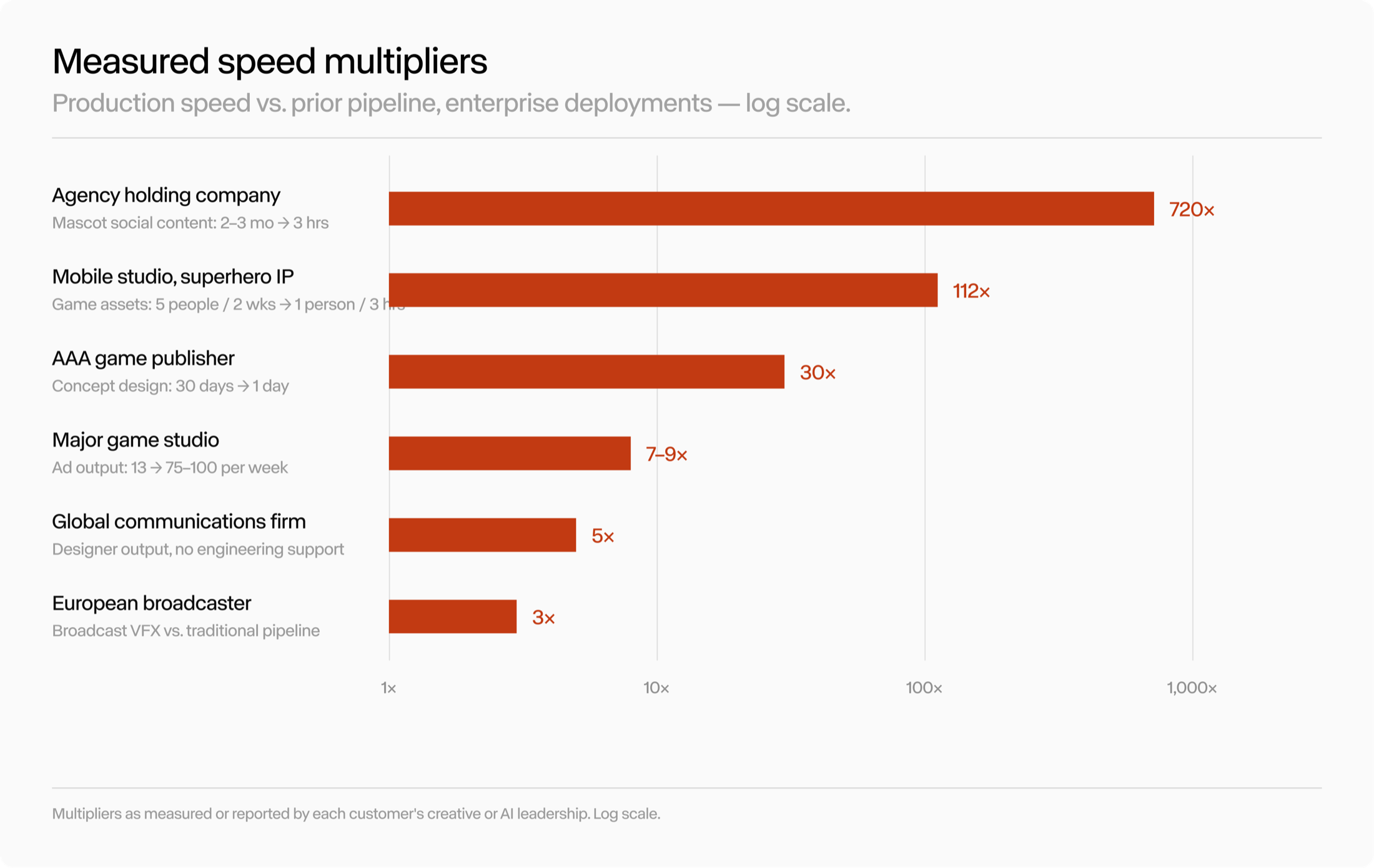
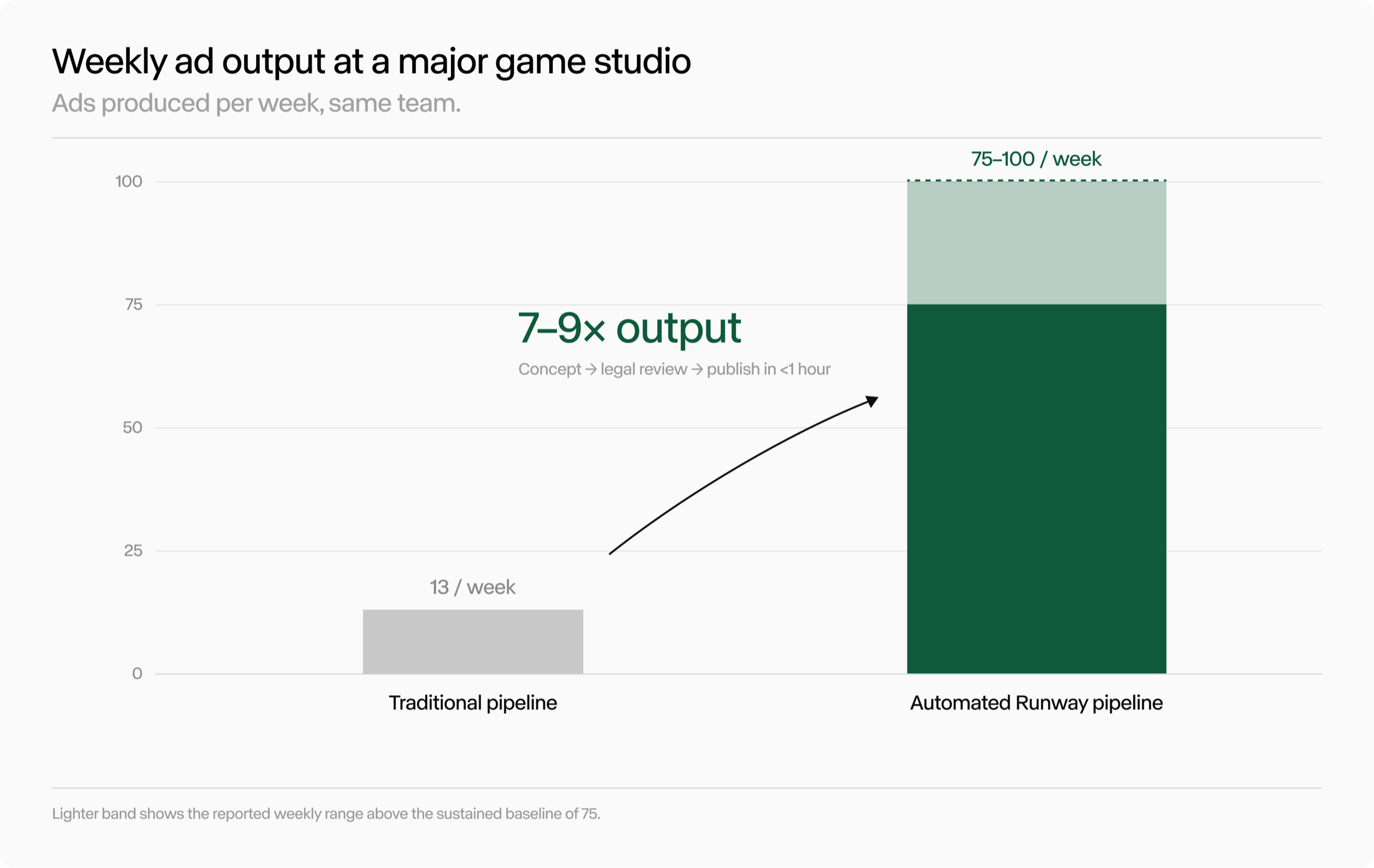
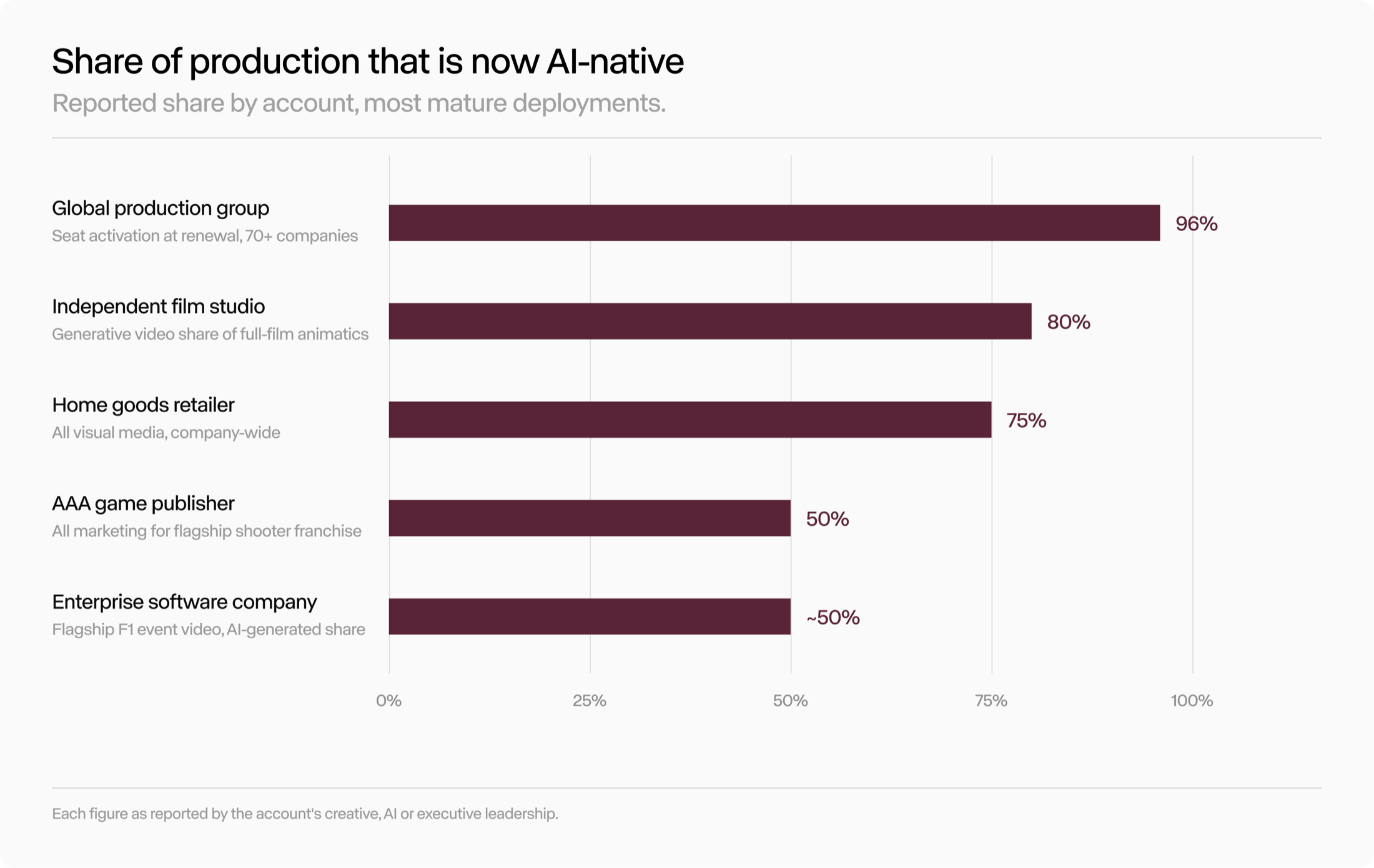
Runway reports one agency group compressing mascot content from two or three months to three hours; a mobile studio moving a two-week, five-person asset process to one person working under three hours; and a game studio increasing weekly advertising output from 13 assets to 75–100 with the same team. The last example is the most important because it shows the rebound effect: cheaper production does not simply save budget. It creates demand for more production.
That changes the bottleneck. When generation becomes abundant, brief quality, reference control, selection, brand review, legal review, trafficking, localisation and performance analysis can become the expensive stages. A team that measures only generation speed may celebrate a sevenfold increase in output while quietly multiplying review queues, unused assets and inconsistent releases.
Measure throughput as a funnel: briefs opened, concepts approved, assets generated, assets submitted, assets approved, assets published, assets retained after the first performance review and assets reused. Add median approval time and first-pass approval rate. These numbers reveal whether the system creates useful supply or merely more files.
Use a six-part AI production scorecard
A practical scorecard can fit on one page. First, total approved-asset cost: every external charge plus active human hours at an agreed internal rate. Second, time to approval: brief acceptance to the defined release gate. Third, first-pass yield: the proportion of submitted assets approved without material regeneration or repair.
Fourth, throughput: approved and published assets per team per week, not raw generations. Fifth, commercial outcome: the measure appropriate to the job—completed views, qualified attention, conversion, cost per acquisition, recall, sell-through, internal greenlight rate or another agreed result. Sixth, risk and reuse: rights exceptions, moderation blocks, disclosure requirements, delivery defects, incidents, complaints, takedowns, plus the proportion of prompts, references, workflows and approved components that can be used again.
Keep the denominators visible. Cost per published asset is useful for a localisation pipeline; cost per accepted shot may suit an animatic; cost per winning creative may suit performance marketing. Pair every efficiency number with a quality or outcome measure. Otherwise the system can optimise itself into producing inexpensive work nobody chooses or remembers.
Run a matched pilot before rewriting the budget
Choose a repeatable production class with enough volume to expose the workflow: product cutdowns, performance variants, localisation, end cards, background replacement, animatic shots or another bounded job. Avoid making the first test both a new creative format and a new production method. Select five to twenty real briefs, preserve the existing baseline and agree acceptance criteria before either route begins.
Run the AI route through the controls it would face in production. Use approved source assets, named model versions, access permissions, brand rules, human review, legal review, provenance capture, technical validation and delivery. Track rejected generations and staff interventions rather than reporting only the selected output. A pilot without the eventual release gates is a demo, not an operating case.
At the end, separate three decisions. Stop if the work cannot meet the brief or the risk boundary. Continue learning if quality is promising but repair, review or variability keeps the unit economics weak. Scale only when the matched assets repeatedly pass, the team can explain the cost movement and the downstream outcome justifies the new volume. Record which workflow version earned that decision so the result can survive a model update.
Buy the evidence behind the saving
The most credible AI production partner is not the one with the smallest generation invoice. It is the one that can show the baseline, disclose the scope, reproduce the workflow, account for rejected work, document rights and controls, and connect production changes to a commercial result. Ask to see one real asset travel from brief to approval, not a reel of outputs detached from their operating cost.
Ask vendors and internal teams five questions: What exactly was included in the old and new cost? How many attempts and human hours produced the approved asset? Which release gates were passed? What happened after the content entered market? Which parts of the process remain portable if the model, price or provider changes? The answers connect this ROI test to a model-portable AI video workflow and a commercially safe production process.
Runway's report makes the strategic direction difficult to ignore: pipeline design can break the old relationship between headcount, time and media output. The buyer opportunity is real. So is the danger of managing the change with a credit counter. Measure the finished asset, the system that produced it and the outcome it created. That is how an extraordinary pilot becomes a defensible production decision.
Build
Turn a promising pilot into a production case
Build the workflow, controls and measurement layer that show what AI media really costs to approve, release and improve.
Launching a business of your own? Founder Launch OS connects the brand, offer, website and visual campaign in one guided Codex or Claude Code workspace.
Keep reading