The blank prompt is an expensive place to begin
A capable AI coding agent can build almost anything. That does not mean it knows what your business should say, which offer deserves to lead, what visual references are appropriate or what a complete launch needs. Without context, every session begins with another long explanation. The founder spends time briefing the agent, correcting avoidable assumptions and discovering basic requirements halfway through the build.
That is the blank-prompt tax. It is paid in time, tokens and decisions. The agent may generate a polished answer, but polish does not fix a weak brief. A landing page can still omit the privacy notice, social links, FAQ or publishing instructions. A brand identity can still become a disconnected logo. A campaign can still be a folder of attractive prompts without a coherent visual idea.
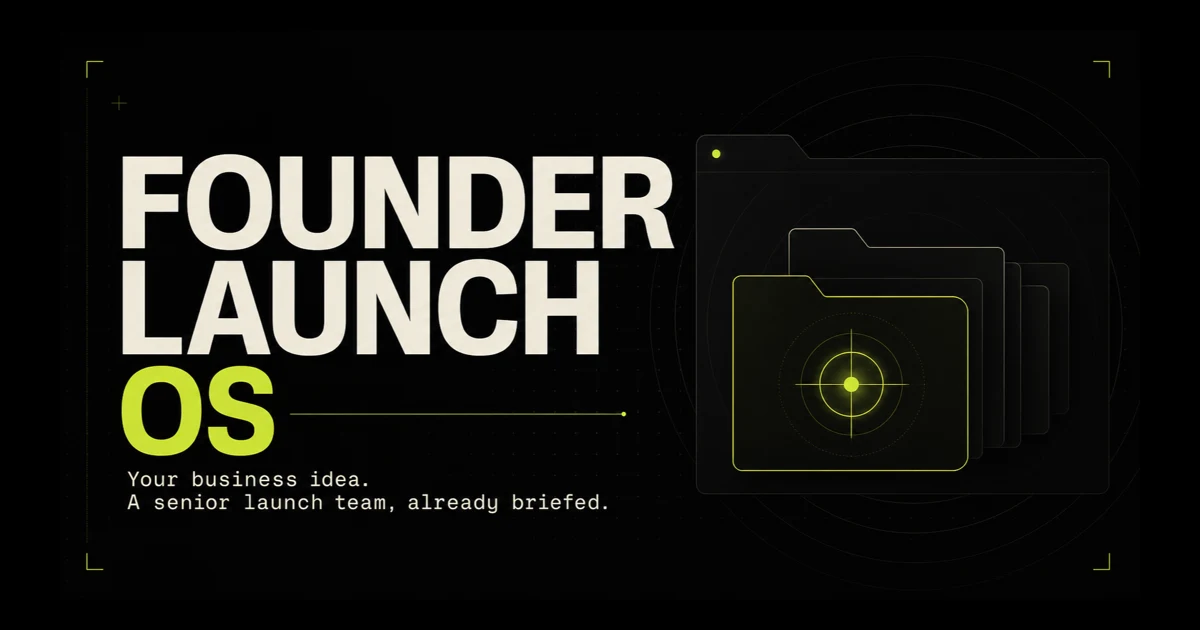
I built Founder Launch OS to give the agent the brief, operating structure and experienced judgment before the founder asks it to make anything.
One folder becomes the working memory for one business
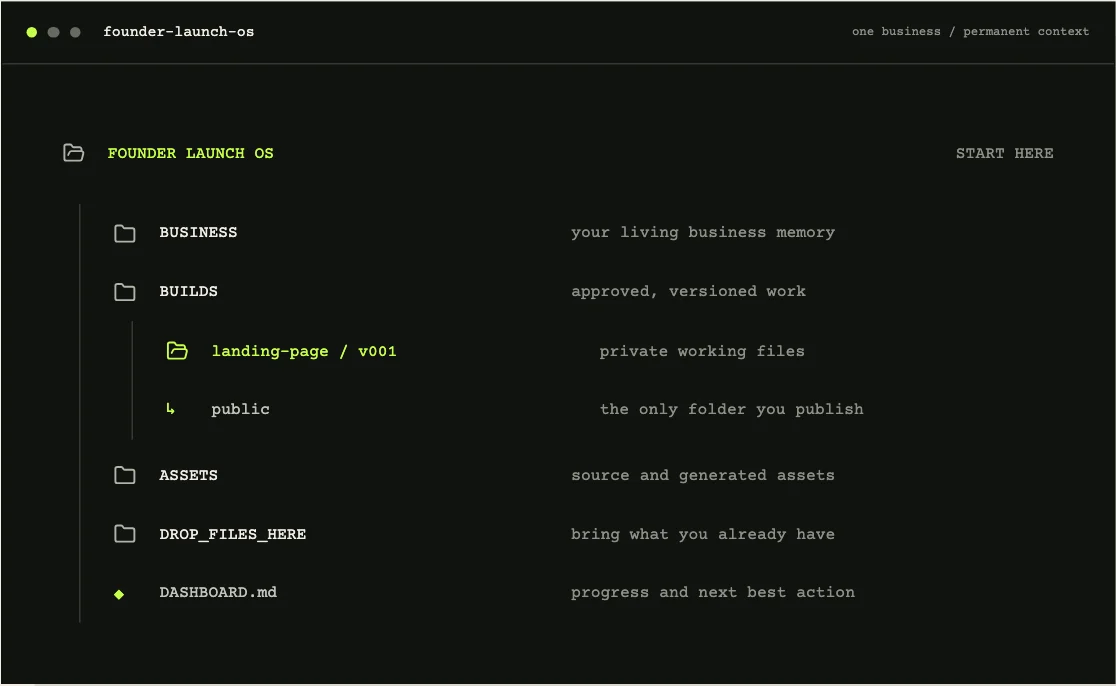
Founder Launch OS is a downloadable project rather than a web dashboard. You unzip it, open the root folder in Codex or Claude Code and type Start. The system introduces itself, inspects any material you have supplied and asks one useful question at a time. You do not need to browse the internal files, select a framework or learn a special command language.
Each accepted answer updates the business memory. Consequential decisions are recorded separately from research and inference, so the agent can tell the difference between something you chose and something it recommended. When you return later, the project knows what has already been agreed instead of asking you to reconstruct the brief.
The constraint is deliberate: one purchase manages one business. Separation prevents brand decisions, customer knowledge and campaign context from bleeding between ideas.
The right specialist appears when the work needs it
The first edition is built around four connected outcomes. Brand identity establishes positioning, colour, typography and editable SVG assets. Offer and pricing turns the business idea into one flagship offer with a clear commercial argument. The landing-page workflow writes, designs and builds a responsive local preview with the structural details a first-time founder may not know to request. The CineRender campaign workflow develops a campaign concept, shot system and enhanced prompts for the founder's preferred image generator.
These are not four unrelated template packs. They share the same business context and approval history. The offer informs the website. The brand rules shape the interface. The customer problem shapes the campaign. A decision made once can influence the work that follows.
The system also challenges the founder respectfully. If an offer is too broad or a design choice conflicts with the audience, it recommends a stronger direction in plain English. Routine, reversible decisions can then happen without creating another approval bottleneck.
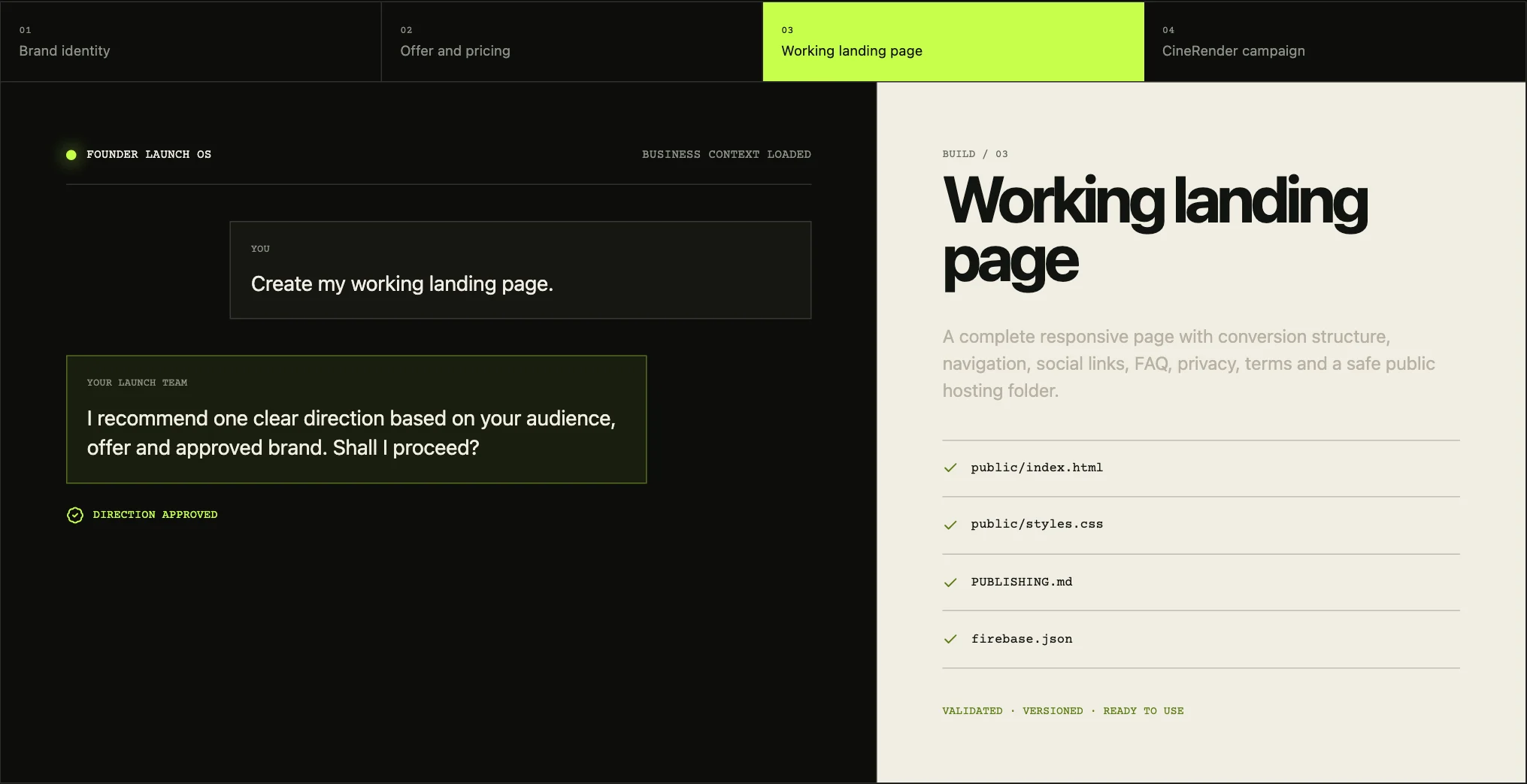
A working website, not a suggestion for one
When the founder chooses a landing page, the result is a working local preview. The workflow accounts for navigation, header, offer structure, social links, FAQ, footer, privacy and terms. It keeps private project material separate from the public directory, then explains what is safe to upload.
Publishing guidance is written for someone who may never have bought a domain or deployed a site. Cloudflare is the recommended domain route and Firebase is the familiar default for hosting, but the output remains platform-neutral enough to move elsewhere. Paid actions and production publishing still require approval.
The goal is not to hide every technical detail. It is to introduce each detail only when the founder needs it, in language they can act on.
Structured context means less wandering
No responsible product can promise an exact token saving because every business and model session is different. The avoidable waste, however, is easy to recognise: repeatedly pasting the same background, asking the agent to rediscover common landing-page requirements, rebuilding a visual direction after context is lost and generating work before the important commercial decisions are settled.
Founder Launch OS reduces that wandering by front-loading the reusable knowledge. Its question plan asks for the minimum important choices. Its routers load the relevant design, offer, website or cinematography guidance only when needed. Its quality gates check the output before it is treated as finished.
That makes the AI agent more useful to a non-technical founder. The founder directs the business; the system carries more of the process.
What Core V1 includes
Core V1 is a one-time paid download for a founder who already has a business idea and access to Codex or Claude Code. It includes the onboarding system, living business memory, brand identity workflow, flagship offer and pricing workflow, complete landing-page workflow, CineRender-enhanced campaign prompt workflow, local verification, safe publishing guidance and maintenance update support.
It does not include hosting, a domain, an AI subscription or finished generated campaign images. Those remain separate services and tools. A dedicated Image Engine may become a future add-on; the current campaign module focuses on creative direction and generator-ready prompts.
The introductory price is £99, reduced from the intended £149 standard price. You can review the full contents, licence and purchase details here.
Download. Open. Type Start.
The intended experience is deliberately short. Purchase Founder Launch OS, download and unzip the folder, open it as a project in Codex or Claude Code and type Start. The first question begins the onboarding; every answer makes the project more specific to the business.
The difficult work has already been placed behind that moment: the question sequence, decision rules, creative references, build standards, separation between private and publishable files, and the checks that make an output usable rather than merely plausible.
Build
Start with the idea. Leave with a launch system.
Open one folder in Codex or Claude, type Start and let the system guide the business from decisions to finished launch assets.
Keep reading