The milestone is a paid seat, not a generated frame
On July 22, Zack London and Fable announced that Gods Don’t Give Gifts would open in US cinemas on October 30. London is the filmmaker behind Gossip Goblin, a channel built around AI-assisted science-fiction shorts. The feature gathers four stories from his Second Cycle of Humanity universe, where bodies, memories and consciousness can be modified or exchanged.
The makers told trade reporters that the film is intended for several hundred cinemas. Variety reported an initial focus on New York, Los Angeles, San Francisco and Chicago, with an unnamed distributor involved. That is an announced release plan, not yet box-office evidence. Public ticketing, the final screen count and the length of the engagement will determine how substantial the booking actually becomes.
That distinction is the point. AI film has accumulated premieres, contests, rented screenings, platform showcases and claims of firsts. A ticketed run creates a harder threshold. Exhibitors need deliverable material, audiences must choose a time and place, critics can review the complete work, and revenue can be compared with the cost of production, finishing, marketing and distribution. The film stops being proof that images can be made and becomes a test of whether demand exists.
The audience arrived before the feature
Fable did not begin with an unproven script and ask a distributor to manufacture awareness. It began with a filmmaker who had spent roughly three years publishing hundreds of pieces inside a recognisable world. Fable CEO Edward Saatchi told Forbes that London’s official YouTube and Instagram work had generated more than 600 million views, approaching one billion when reposts were included. Variety put the YouTube channel at 1.4 million subscribers when the release was announced.
Those are platform and producer figures, not a forecast of ticket sales. A view can be brief, passive, geographically irrelevant or duplicated. A follower can enjoy a two-minute film at no cost and still reject a feature, a cinema journey or a ticket price. The conversion gap between those behaviours is large.
But the order of operations matters. London used short films as both finished work and audience research. Each release tested the world’s visual language, story premises and appetite before a feature asked for a larger commitment. For an independent producer, that reverses the old assumption that audience development begins once the film is locked. Here the audience history is part of what makes the feature financeable and bookable in the first place.
An anthology is a sensible long-form bridge
Gods Don’t Give Gifts is not reported as one continuous two-hour narrative. Its four stories share a universe and a question: what happens to ordinary human wants when technology removes familiar physical limits? Structurally, that is a useful bridge from short-form publishing to a theatrical feature. It lets the filmmakers preserve the concentrated, high-concept form in which the audience already knows the work while building a full evening around it.
The format also contains production risk. A generative sequence can fail when a character, location or performance must remain coherent across a long dramatic arc. An anthology can reset cast, setting and visual rules between chapters while retaining a consistent world. It does not remove the need for continuity, but it keeps every technical failure from propagating across the entire running time.
That should not be mistaken for a shortcut around feature storytelling. Four shorts still need cumulative rhythm, tonal progression and a reason to sit together. The cinema audience will judge the spaces between the set pieces: whether dialogue holds, whether characters accumulate meaning and whether the edit can sustain attention after the novelty of the imagery has faded.
Pomegranate gives the audience proof before purchase
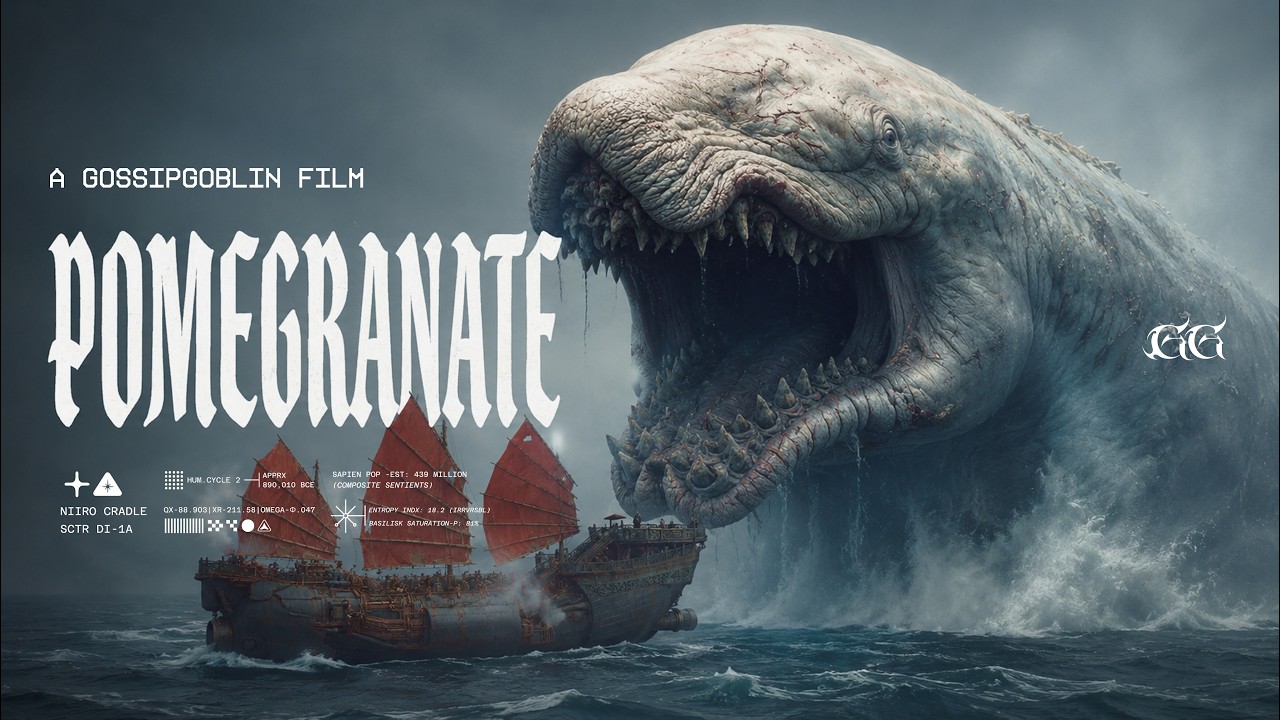
The release announcement arrived with something more persuasive than a deck. Gossip Goblin published Pomegranate, a 28-minute film from the same fictional universe, free on YouTube. The piece places a ship beneath a colossal sea creature, moves through new bodies and memory systems, and gives a potential buyer enough uninterrupted material to decide whether the world can sustain more than a reel of striking shots.
This is good audience design. A trailer asks viewers to trust the selection. A substantial short lets them test the pacing, sound, performance and dramatic logic for themselves. It also gives the release campaign an owned piece of evidence that can travel long before tickets are available.
For producers, the lesson is not to give away half a feature indiscriminately. It is to choose a proof asset that answers the buyer’s main objection. In this case the objection is not whether London can make one arresting AI image; his feeds already establish that. The objection is whether the work can hold attention across scenes. Pomegranate is designed to answer that question in public.
Theatrical finishing makes the human pipeline visible
The label ‘AI-generated film’ compresses a production into one misleading phrase. London and Saatchi told NewsNation that the project used a full creative team, including designers and voice actors, with AI as one part of the process. Forbes reported that the feature kept human voice performers, musicians and a Foley artist. At announcement, the picture was complete and the team was still adjusting the audio for cinemas.
That last stage matters. A stream watched through a phone can disguise weak sound perspective, unstable ambience and thin dynamics. A cinema mix exposes them across a large room. Dialogue must remain intelligible, effects need scale and placement, music has to carry transitions, and the complete programme must meet the distributor and venue’s technical requirements. AI may lower the cost of constructing visual scale, but it does not eliminate the delivery discipline that makes a feature screenable.
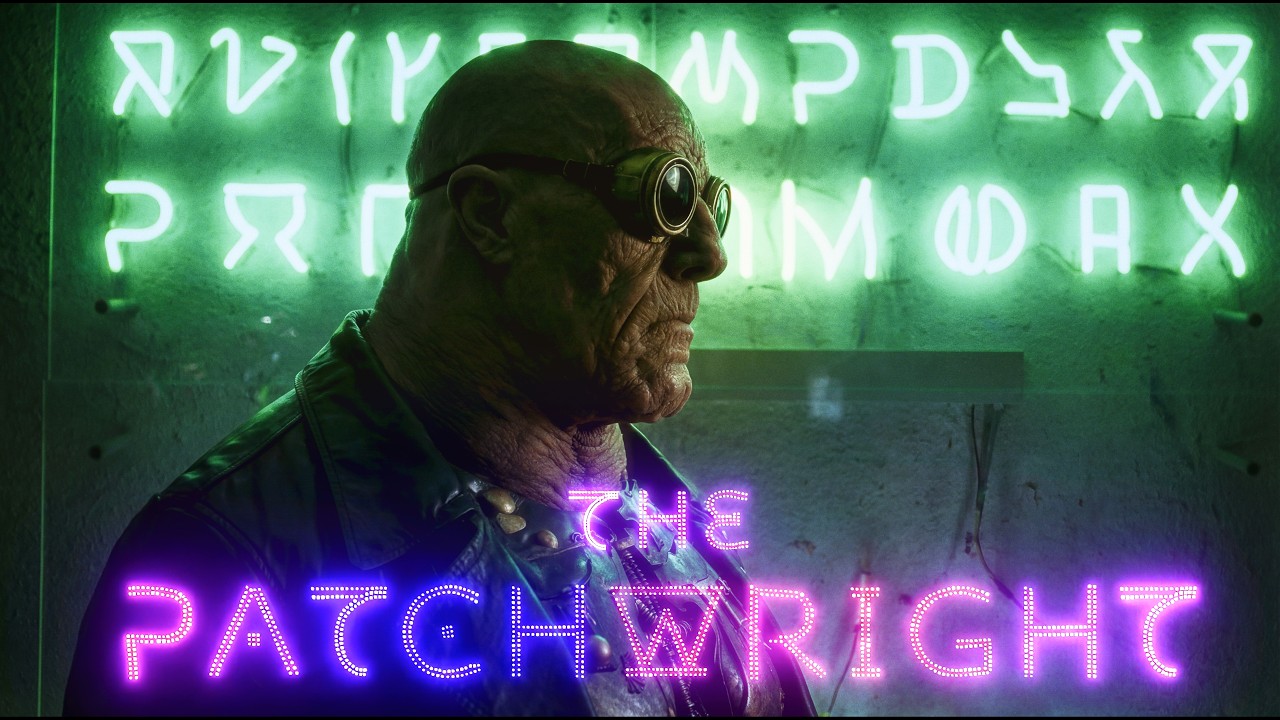
London’s earlier short The Patchwright makes the division of labour concrete. Its published credits include writing, direction, visual design, cinematography, animation, colour, editing, score, sound design, effects, Foley and re-recording. Those roles are not incidental footnotes to prompting. They are the system that turns generated material into authored moving-image work.
The fan-film contest turns marketing into world-building
Fable also plans a $15,000 fan-film competition set inside London’s universe, with the winner due to be announced on release day. Strategically, that converts promotion from repetition into participation. The audience is not only asked to watch a trailer; it is invited to learn the world’s rules, make within them and circulate new entry points to the IP.
That can deepen attachment, but it needs clearer governance than an ordinary hashtag campaign. Entrants need to know what rights they retain, what licence the organiser receives, which AI services and source materials are permitted, how human contributors must be credited, whether likenesses and voices require consent, and whether a winning character or story can be used in later commercial work. The more valuable the world becomes, the more important those boundaries become.
The contest therefore tests another part of the creator-studio model: whether a centrally authored universe can expand through community production without turning fandom into ambiguous unpaid development. A clean licence and visible credit system would make the audience mechanism stronger, not slower.
October 30 needs a commercial scorecard
The release is scheduled for the Friday before Halloween, a useful date for a science-fiction and horror-tinged event. Genre, a specific night and an existing online community can turn a limited run into a gathering rather than another title waiting for casual discovery. But the campaign should resist using one sold-out screening or a global view count as proof of a new distribution model.
The useful scorecard begins with booked screens, sessions and seats by market. It then tracks tickets sold, occupancy, revenue per screen, refunds, paid and organic marketing cost, conversion from London’s owned channels, repeat or referral behaviour, audience ratings and the performance of cities outside the creator’s strongest geographic clusters. On the production side, it should include total human labour, compute, rejected generations, post-production, mastering, insurance and delivery—not just the cheapest visible stage.
The film does not need blockbuster numbers to matter. A low-budget event can succeed by reaching break-even, proving demand in selected markets, increasing the value of the underlying world or creating a credible next financing step. What it cannot do is claim victory before the audience has been asked to pay.
Copy the sequence, not the headline
The reusable pattern is clear: develop a recognisable world through finished short work; learn which ideas earn voluntary attention; preserve human authorship where performance and craft matter; choose a long-form structure that contains technical risk; publish a substantial proof asset; then use a time-bound event to convert the audience into a measurable market.
What should not be copied is the assumption that AI alone produces that leverage. Most projects do not have hundreds of millions of prior views, a three-year publishing history or a producer willing to organise theatrical distribution. Generative production can reduce the cost of visual ambition, but it cannot supply accumulated trust on demand.
Gods Don’t Give Gifts is high-signal because it connects production practice, IP development, community participation and cinema distribution inside one case. Its October run will reveal whether that connection holds. Until then, the strongest claim is also the most modest: an AI-assisted filmmaker has built enough audience and enough finished work to earn a real commercial test. The result, not the announcement, will tell the industry what comes next.
Build
Connect the production system to the audience system
I help film, media and commercial teams turn AI production experiments into controlled workflows, accountable deliverables and audience journeys that can be measured beyond the demo.
Launching a business of your own? Founder Launch OS connects the brand, offer, website and visual campaign in one guided Codex or Claude Code workspace.
Keep reading