The next scene does not have to exist yet
Most of the conversation around AI video still starts with the shot. How convincing is the movement? Does the character stay consistent? Can you direct the camera without the whole scene rearranging itself? Those remain useful questions, particularly if you need footage that will survive an edit.
Infinite Slop raises a different one: what happens when the audience can help decide what gets made while the programme is already running? The viewing experience starts to move from a catalogue of finished work towards a conversation with a production system.
As a cinematographer and creative technologist, that is the part I find interesting. A better generator changes how we make images. A generator connected to an audience can change the shape of the entertainment itself. It deserves a closer look than either “cinema is over” or “it is all slop”.
What H3 Max actually changes
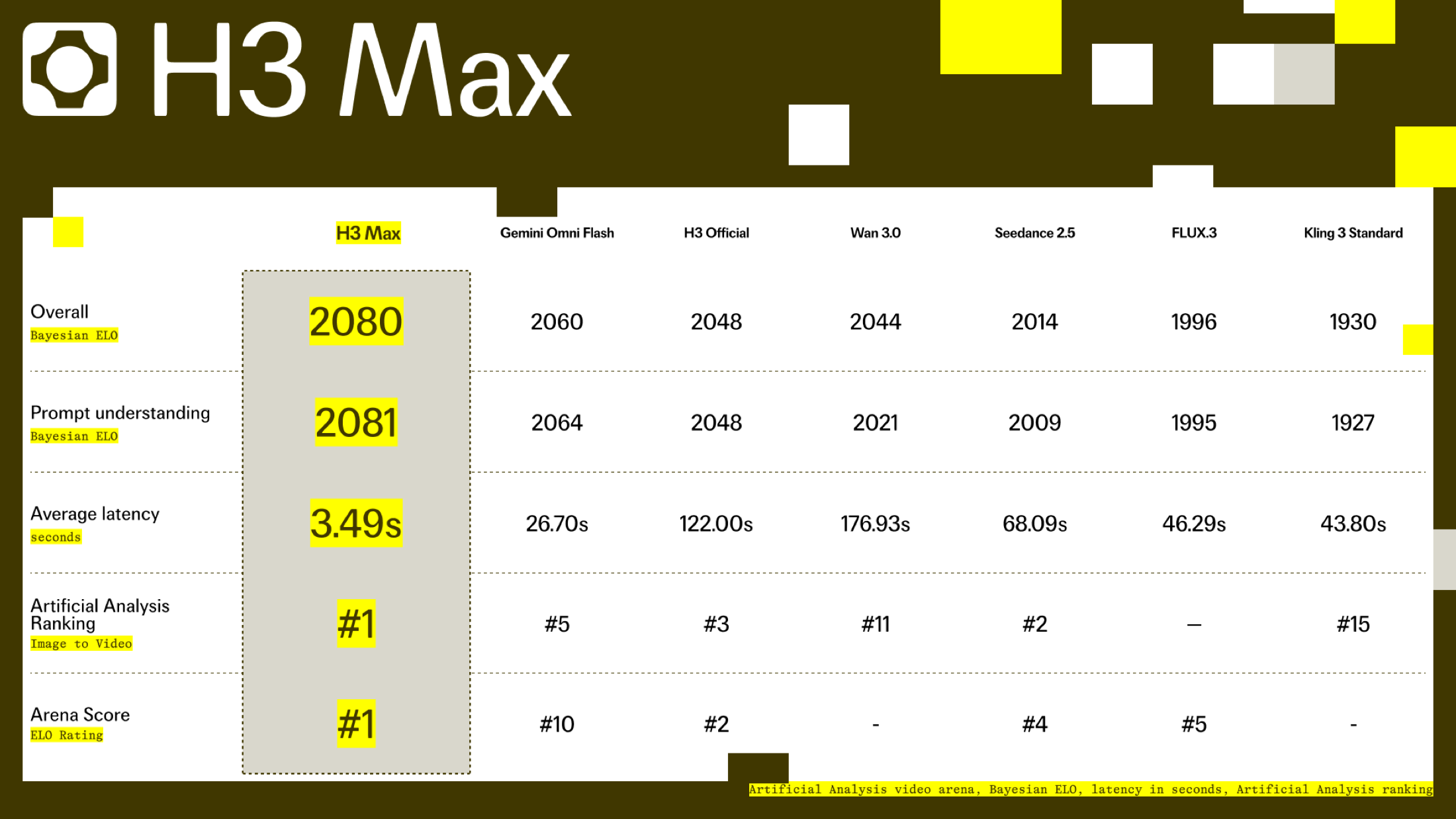
The naming needs a little care. The model being discussed as Hailuo H3 Max is H3 Max, fal’s post-trained version of MiniMax H3. fal announced it on August 26, with model development and inference optimisation carried out together. It retains native synchronised audio and video.
fal reports generating a five-second video in under three seconds. That is a vendor benchmark, not a guarantee for every prompt or a latency test I have run. The accompanying launch graphic reports a different average latency of 3.49 seconds; those figures should not be collapsed into one universal promise.
The useful threshold is simple: if the next clip can be prepared before the current clip finishes, a buffered sequence can keep playing. Queue delays, rejected outputs, delivery and transitions still matter. Faster generation creates room for a continuous experience; the surrounding product has to make it work.
Infinite Slop turns generation into a shared channel
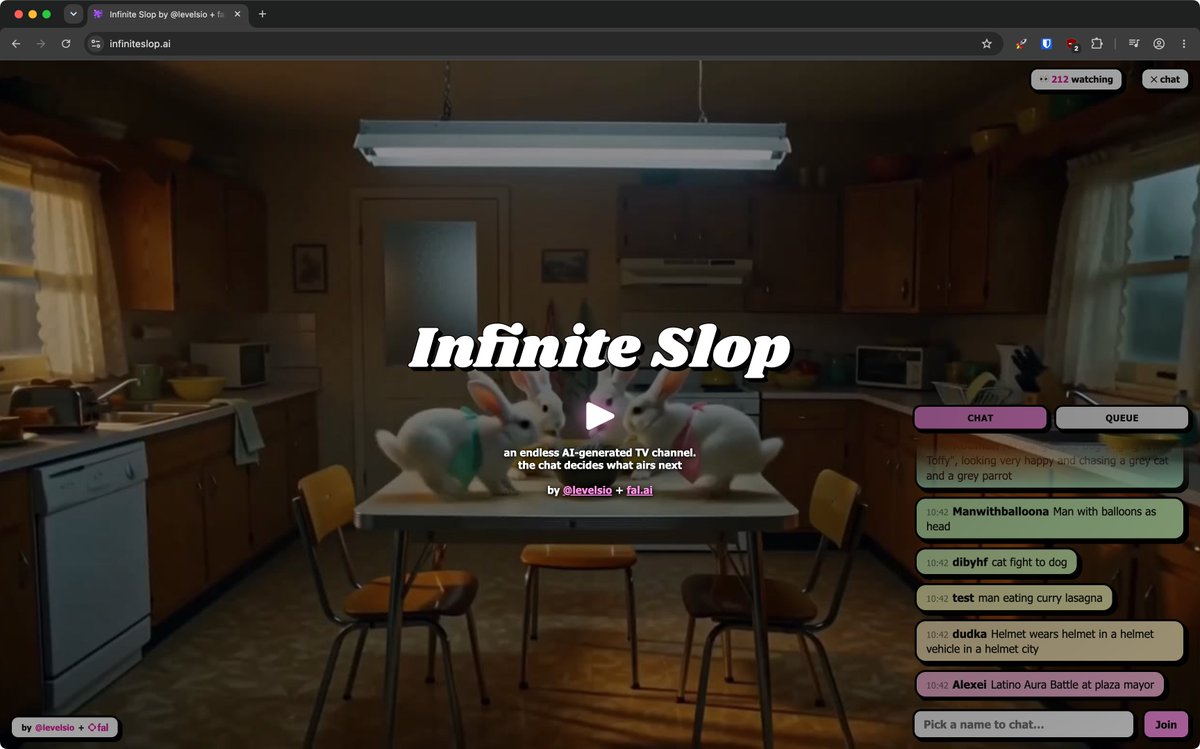
Pieter Levels introduced Infinite Slop on August 29, crediting earlier stream experiments by Marc-Antoine and Rehan Sheikh and fal’s sponsorship of the generation. The idea is a public stream where audience suggestions influence what appears next.
The live website places playback alongside chat, queue and ranking controls. That combination matters: the audience has somewhere to propose an idea and somewhere to see how the collective programme is progressing. It is a social space as well as a video player.
In his August 30 follow-up, Levels described four fifteen-second videos per minute and acknowledged that busy periods mean not everyone gets a turn. He also described using the previous clip’s last frame as a continuity challenge. We should not mistake a continuous broadcast for a proven, seamless long-form narrative.
Watching becomes a form of participation
The attraction of a format like this may be the possibility that your suggestion becomes the next public moment. You stay to see whether it appears, how it is interpreted and how everyone else responds. A strange result can become a running joke. The audience supplies part of the context that makes it entertaining.
That creates a different relationship with attention. A conventional feed asks which existing clip will keep you watching. A generative channel could also ask what it should make next to keep you involved. Production and distribution begin reacting to the same audience behaviour.
There are enjoyable possibilities here: a hosted comedy format, an audience-led creature feature, an improvised late-night channel with recurring characters. There is also an obvious risk of endless escalation, where each prompt has to be stranger than the previous one to earn attention. The system’s choices about selection and pacing will shape the culture of the room.
The creator’s job expands to include the rules of participation. Who gets airtime? Can a quiet but good idea survive a loud chat? Can the programme hold a scene long enough for a joke to land? Those are editorial decisions with an interface attached.
Shared television and personalised television pull in different directions
One possible future is a channel made for a particular group. A community gathers around the same characters, influences the same sequence and remembers the same moments. Its appeal comes partly from being there with other people when something unexpected happens.
Another possibility is a private stream shaped around one person’s tastes. Imagine asking for a slow science-fiction mystery with a particular atmosphere, then redirecting it as you watch. That is a plausible direction for the technology, not an established capability I am claiming for Infinite Slop.
The distinction matters culturally and commercially. A shared channel can generate a clip once and distribute it to many viewers. A fully individual stream needs its own continuing output, which changes the generation cost. A shared programme also gives people something to discuss afterwards. Personalisation can make the experience more relevant while reducing the number of people who experienced the same thing.
I would not assume that maximum personalisation is automatically better entertainment. Sometimes the pleasure is surrendering to somebody else’s taste. You discover a film because its maker sees the world differently from you. A system that always gives us what we ask for could become remarkably good at keeping surprise within comfortable limits.
An ending may become a stronger creative choice
From a filmmaking perspective, a scene has value because of its relationship to the rest of the work. A close-up arrives after we have learned something. A camera move reveals information at a chosen moment. A cut withholds the reaction we expected to see. The audience is being guided through an experience.
Continuous generation can produce events without making those events accumulate into meaning. A character appearing repeatedly is not the same thing as a character changing. A visual transition is not the same thing as dramatic causality. Those distinctions become more important as the output gets easier to produce.
There is an opportunity for writers, directors, editors and cinematographers here. Someone still has to decide the visual grammar, what the audience can influence, what a character remembers and which consequences cannot simply be prompted away. A mystery needs constraints if its eventual answer is going to matter.
In a media environment that can always continue, stopping becomes a positive creative act. A ten-minute experience with a satisfying resolution might be more valuable than another hour of plausible incident. The ability to finish could become part of the promise we make to an audience.
The opportunity is to design a format worth returning to
If I were developing an experience around this capability, I would begin with a small, recognisable format: one world, a limited cast, a host or editorial voice, and a clear period in which audience suggestions can affect events. Give viewers choices they can understand and consequences they can recognise.
I would measure whether people return for the programme as well as whether they stay for the novelty. Do they remember a character? Can they describe a moment to someone else? Do they feel their contribution mattered? Watch time alone cannot tell you whether you made something rewarding or merely difficult to leave.
The production system would also need a broadcast delay, checks on audience submissions and generated output, and a fallback when generation fails. Those are practical requirements for a public format, particularly when a scene can be created and distributed before a person has watched it all the way through.
H3 Max and Infinite Slop make the possibility tangible: media can be produced in response to the people consuming it, quickly enough to feel like an ongoing exchange. My expectation is that this will create new forms alongside authored films and television. The strongest ones will give us a reason to care about what happens next, and know when what has happened is enough.
Build
Need a repeatable AI production workflow?
Mike designs the tools, review loops, and publishing systems that make it usable.
Launching a business of your own? Founder Launch OS connects the brand, offer, website and visual campaign in one guided Codex or Claude Code workspace.
Keep reading