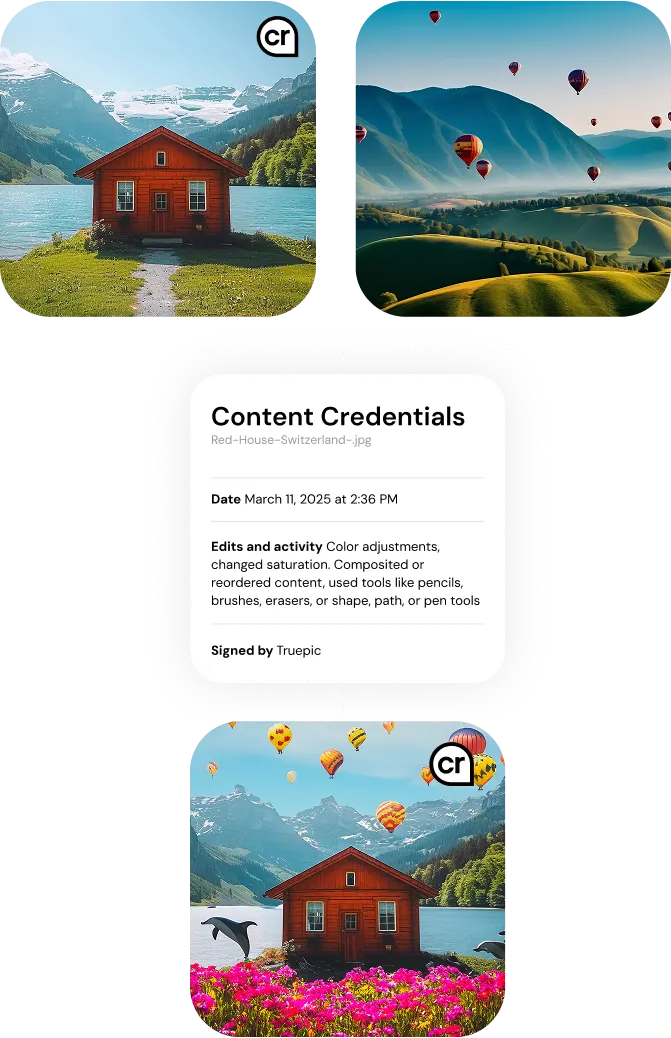
Answer first: evidence has to travel with the creative
Four developments this week move provenance and approval closer to everyday creative work. A text model can add a detectable signal, a public tool can inspect supported media from several providers, an advertising agent can turn performance evidence into campaign actions, and an agency programme can require chain-of-custody records before generated work reaches public screens.
For a production team, brand, agency, studio or founder, the useful shift is not that software can declare an asset safe. It is that verification can become a repeatable acceptance test. The buyer should receive the source asset, machine-readable signal where available, external rights and consent record, human review, disclosure decision, final file hash and named approval as one delivery object. This follows the Friday buyer-intent theme of owned evidence, approval gates and commercial handover without forcing weak search-query evidence into the news.
The boundary matters. Provenance can indicate that a participating system generated or processed material. It does not determine whether the work is true, original, legally usable, properly disclosed or approved for this campaign. The AI provenance review workflow and commercially safe AI video checklist join those different questions instead of collapsing them into one badge.
Signal 1 — October 5: Text watermarking reaches a limited rollout
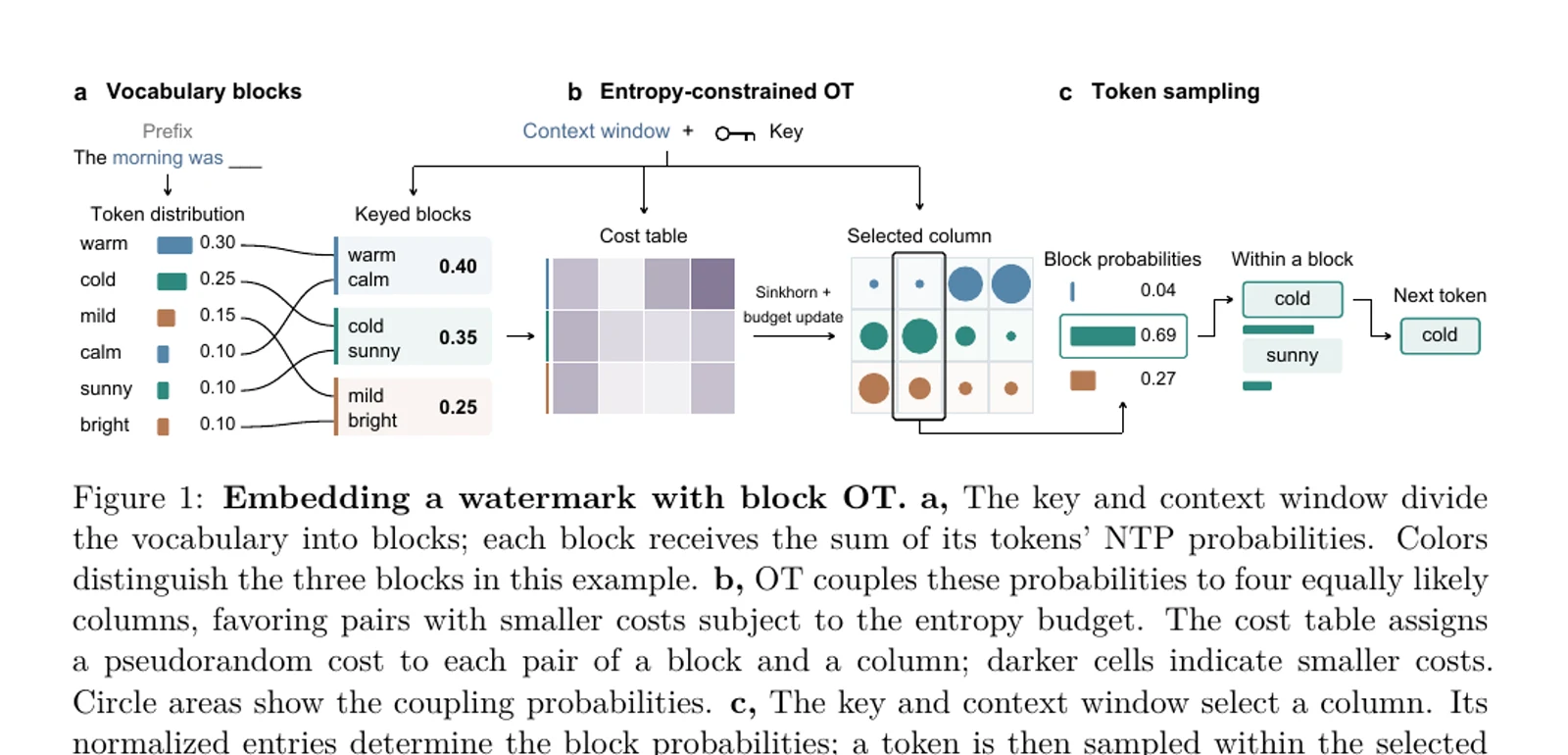
OpenAI opened opt-in text watermarking to API customers for selected models and said eligible ChatGPT and Codex text in the European Union will receive an invisible watermark over the following weeks. Initial detector access is limited to approved researchers and expert organisations. The accompanying textGrain report describes a statistical signal added through model word choices rather than metadata attached to a file.
Why it matters: text provenance is entering operational use with unusually clear limits. OpenAI reports that, at a 1% target false-positive rate, detection reached about 80% for 200-token psychology passages and about 95% for 400-token passages. Editing weakens the signal: replacing 10% of words in one 400-token evaluation reduced detection from about 92% to 66%, and replacing 25% reduced it to 17%. Short, constrained, translated and rewritten material therefore needs careful interpretation.
What to do: decide where a detectable model-origin signal is useful before enabling it. Keep the untouched output, model and feature state, prompt or instruction record, editor, revision history and approved final copy. Do not reject a contributor, approve a claim or infer human authorship from a detector result alone. Build an appeal and manual-review route for both positive and negative results, then store the result as one field in the provenance review, not as the verdict.
Signal 2 — October 6: Creative performance starts steering the campaign agent
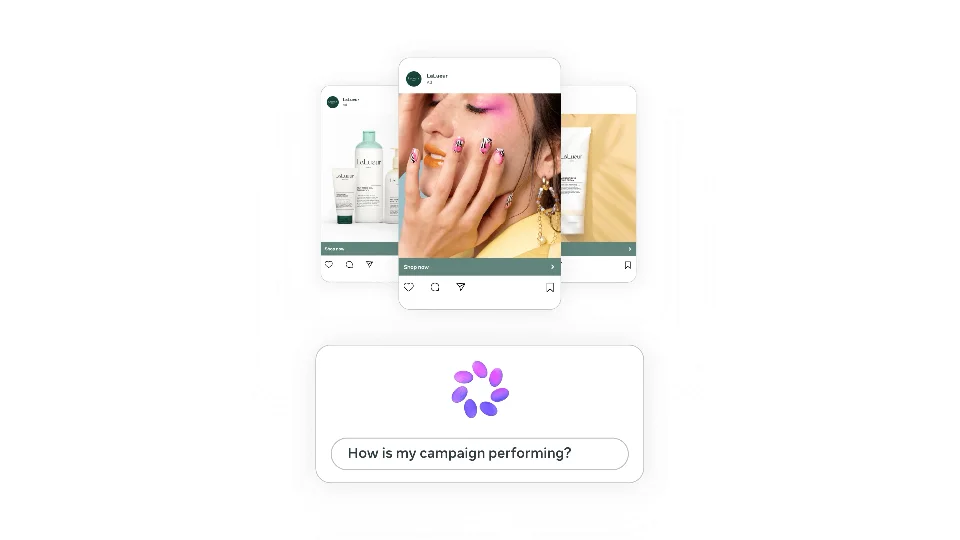
Meta began a wider rollout of Ads Creative Studio, bringing its creative-performance insights into the Meta AI business assistant in Ads Manager. New capabilities in testing can plan and create campaigns, generate images and copy, change targeting or budgets, schedule monitoring tasks and carry deeper business context between conversations. Meta's Ads MCP server can now upload creative, preview placements and return agent-prepared work to Ads Manager as a draft; Meta says advertiser permissions and explicit approval apply before publication.
Why it matters: the loop between creative analysis, variant generation, targeting and spend is becoming executable in one system. Meta says advertisers adopting assistant recommendations typically see 5% more conversions at the same cost per conversion, but the announcement does not publish a sample, study design or independent validation, and that aggregate result should not be treated as the expected return from the new agentic features. Performance evidence can guide a test; it should not silently rewrite the brief or move the budget.
What to do: separate read, draft, publish, targeting and spend permissions. Require a new approval when the audience, claim, destination, creative source or budget changes. Keep the baseline asset and campaign objective beside every generated variant, and log which performance signal caused which proposed action. Run the resulting asset, media setup and disclosure as one object through the AI advertising disclosure gate, with a human owner for the final publish decision.
Signal 3 — October 7: Media detection becomes public and cross-provider
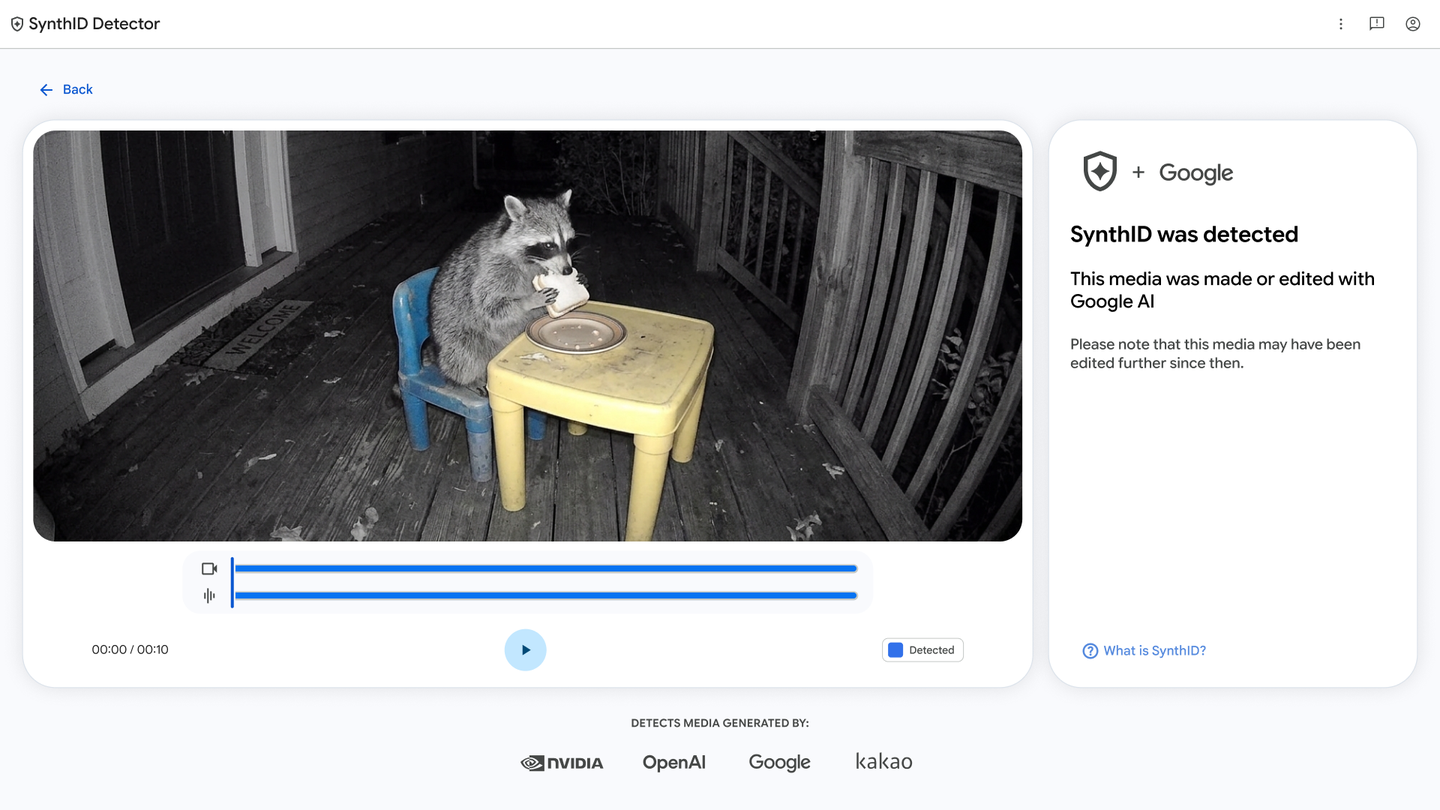
Google made the SynthID Detector available globally in English. The tool checks supported image, video and audio for invisible SynthID signals from Google and participating providers including OpenAI, NVIDIA and Kakao, with Apple listed as coming soon. Google reports that SynthID has been applied to more than 180 billion images and videos and 240,000 years of audio, while verification features across Search, Gemini and Chrome now handle more than one million requests a day.
Why it matters: a producer, publisher or platform no longer needs privileged access to run a supported media check. Cross-provider participation also makes the detector more useful than a single-vendor badge. But a positive result establishes only that a participating system's signal was found, and the product image itself warns that the media may have been edited afterwards. A negative result cannot prove that a file is human-made, unedited or clear of rights problems.
What to do: add a detector pass at ingest and again on the proposed master, then preserve both results with the exact file hashes. Test the real delivery path—edit, composite, transcode, upload and platform download—to learn whether the signal survives. If it disappears, retain the source result and external manifest rather than declaring provenance lost. If it remains, continue the ordinary checks for consent, licences, claims, disclosure and final approval in the commercial-safety workflow.
Signal 4 — October 7: An agency framework reaches a live outdoor brief
Advertising Council Australia published the governance framework behind its inaugural AWARD Lab GenAI Sprint. Teams used Leonardo.Ai on a live behavioural brief for AUSVEG and +ONESERVE, with the winning work progressing to national digital-out-of-home deployment through the Outdoor Media Association network. The process required timestamped full-screen logging, verified source assets, pre-cleared third-party material, production-specialist involvement and formal representation, fairness and bias checks.
Why it matters: this is a concrete bridge between a sandbox sprint and public delivery. ACA reports that, among 25 Australian CCOs and ECDs it asked, 60% cited IP and copyright ownership as a primary compliance concern, 56% brand integrity and visual consistency, and 52% each cited direct legal liability, privacy and reputational risk. Those figures are a small industry sample, not a market-wide measure. The stronger evidence is procedural: a real brief forced governance into the making and judging process rather than leaving it in a policy PDF.
What to do: convert the framework into production fields. For every candidate, retain the source class, licence or client approval, creator, prompt or direction history, tool and account, representation check, craft/channel review and decision owner. Price the logging and review time into the schedule instead of pretending governance is free. The AI production workflow stack provides the handoff structure; the client should own the final register and approved masters.

One operating move for the week: create a verification receipt
Choose one asset moving toward client approval and issue a verification receipt beside it. Record the project and asset ID, source hash, creator and account, model or tool, generation and edit dates, embedded credential or watermark result, detector and version, rights and consent references, disclosure decision, human reviewers, approved master hash, destination and retention owner.
Then write what the receipt does not prove. It does not establish factual accuracy, originality, ownership, performer consent, brand approval or legal clearance unless the linked evidence covers those questions. If a detector returns no signal, record 'not detected' rather than 'human-made.' If a signal is found, record the supported provider and file state rather than guessing who made it or why.
Finally, pass the asset through one destructive delivery step—a transcode, composite, resize or platform upload—and repeat the check. The production is ready to scale when the team can still connect the final file to the approved source and decision record even after an embedded signal disappears. That portable receipt is the buyer-facing deliverable strengthened by every signal this week.
Build
Need a repeatable AI production workflow?
Mike designs the tools, review loops, and publishing systems that make it usable.
Launching a business of your own? Founder Launch OS connects the brand, offer, website and visual campaign in one guided Codex or Claude Code workspace.
Keep reading